
PAS 2000:2026: Safer Laminated Glass with EVA, SGP and PDLC
On 28 February 2026, the British Standards Institution published PAS 2000:2026, Construction products – Bringing safe products to market – Code of practice. Sponsored by the UK Office for Product Safety and Standards, the voluntary code provides a due-diligence framework for manufacturers and other economic operators that place construction products on the UK market.
For the laminated-glass supply chain, PAS 2000:2026 is important because product safety is not established by a single test report or material claim. It depends on connecting the intended use of a product with risk assessment, material selection, factory production control, accurate technical information, traceable records and feedback after sale.
E&N HONJIA supplies EVA interlayers for laminated glass, ionoplast interlayers and PDLC smart film for laminated glass. Our product and technical-support approach can help glass processors, importers and project partners build a more transparent and evidence-based product-safety process.
Important clarification: PAS 2000:2026 is a voluntary code of practice, not a product certification for EVA film, ionoplast interlayer, SGP interlayer or PDLC film. Using an E&N HONJIA material does not by itself make a finished laminated-glass assembly compliant. The finished glass must still be correctly designed, processed, assessed and documented for its intended use under all applicable legal and technical requirements.
What Does PAS 2000:2026 Cover?
According to BSI's official PAS 2000:2026 overview, the code addresses four core areas:
- pre-market risk assessment;
- factory production control processes;
- product information and documentation; and
- collection and use of market feedback.
The code is relevant not only to construction-product manufacturers, but also to importers, distributors, designers, specifiers, contractors, installers, building owners, regulators, conformity-assessment bodies, insurers and warranty providers.
The UK Office for Product Safety and Standards also explains that PAS 2000:2026 does not replace legal obligations. Instead, it describes good practice that can help businesses show that they have taken reasonable steps to ensure that construction products are safe for their intended use.
Why PAS 2000:2026 Matters to Laminated Glass
A laminated-glass interlayer is only one component of the finished glazing system. Real-world safety can be affected by:
- the type and thickness of the interlayer;
- the glass type, thickness, size and edge quality;
- the supporting and fixing system;
- the lamination temperature, time, pressure and vacuum performance;
- indoor or outdoor exposure;
- temperature, humidity, ultraviolet radiation and edge conditions;
- impact, loading and required post-breakage behaviour;
- compatibility with inserts, coatings, sealants and other materials; and
- electrical design, wiring and edge protection in PDLC smart glass.
For this reason, a statement such as "high-strength interlayer" is not enough for a safety-critical project. The material must be matched to a clearly defined application, and the finished laminated glass must be validated as a complete construction product or system.
How E&N HONJIA Supports a PAS 2000:2026-Aligned Approach
1. Product Selection Starts with Intended Use
PAS 2000 : 2026 places intended use at the centre of product-safety due diligence. E&N HONJIA therefore recommends selecting an interlayer by application and risk, not by transparency or price alone.
Our EVA portfolio includes different formulations for indoor, outdoor, decorative and functional laminated glass:
- HJ-WB for indoor clear laminated-glass applications;
- HJ-WA and HJ-WH for outdoor clear laminated glass, with different flow characteristics;
- HJ-AT and HJ-HT for extra-clear architectural laminated glass, also offering different flow characteristics;
- HJ-PL ultra-clear EVA interlayer for PDLC smart-glass lamination; and
- coloured, opaque and frosted EVA series for decorative laminated glass.
For applications requiring higher stiffness, load transfer or demanding post-breakage performance, an ionoplast interlayer may be considered. Typical applications can include balustrades, canopies, skylights and façades, but the suitability of any glass build-up must be confirmed through project-specific engineering and applicable testing.
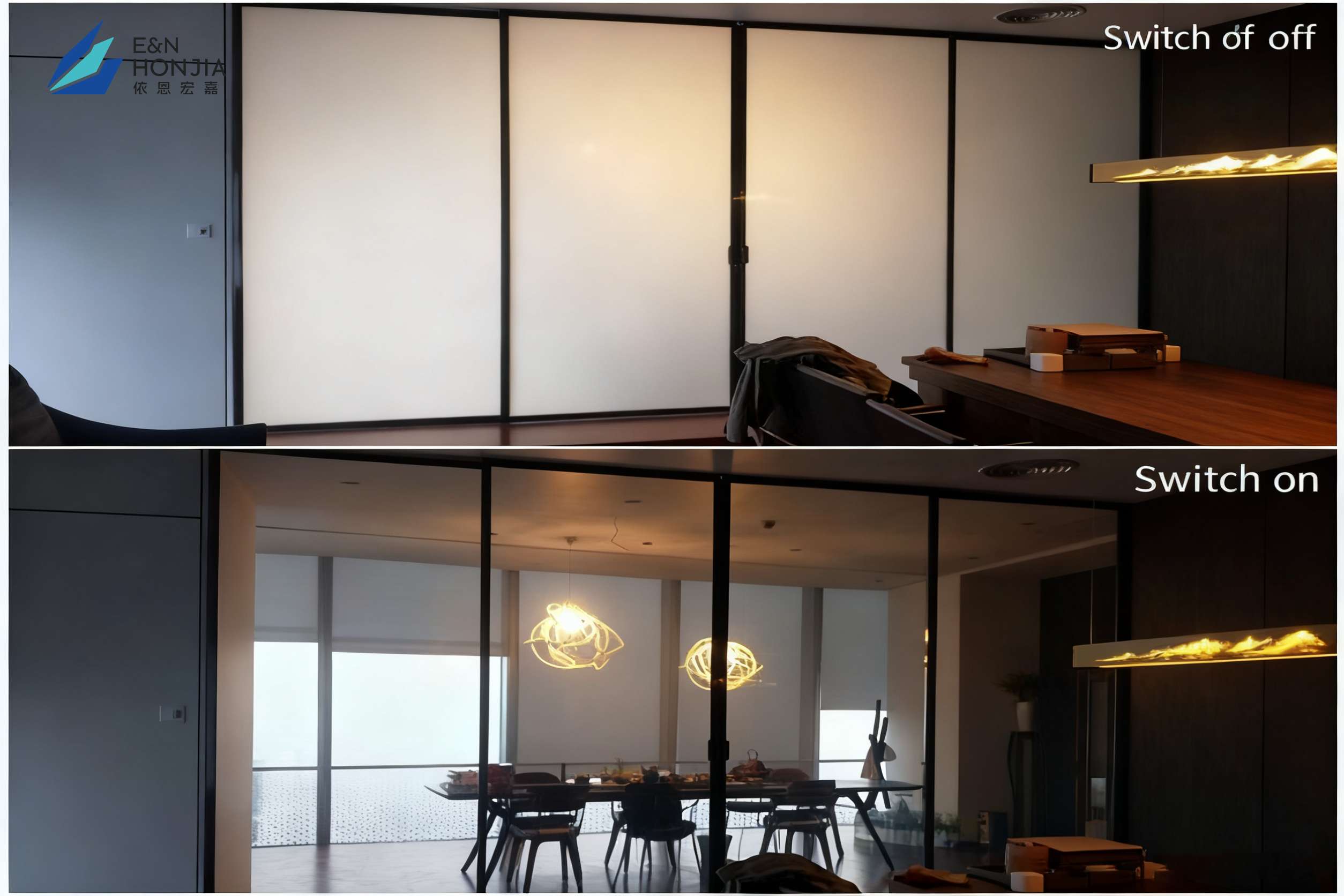
For switchable privacy glazing, E&N HONJIA offers PDLC smart film for lamination and related smart-glass solutions. PDLC projects require evaluation of both the laminated-glass construction and the electrical system.
Before recommending a material, the following information should be defined:
- What is the intended application?
- Is the glass for indoor or outdoor use?
- Is it decorative, protective, structural or safety-critical?
- What are the glass build-up, panel dimensions and support conditions?
- What environmental exposure is expected?
- What impact and post-breakage performance is required?
- Does the assembly include PDLC film, inserts, coatings, sealants or electrical components?
This application-first process reduces the risk of using a technically good material in the wrong glass construction.
2. Pre-Market Evaluation and Sample Validation
PAS 2000 : 2026 encourages risks to be considered before a product is placed on the market. For laminated-glass processors, this means checking not only the interlayer specification but also the complete production route.
E&N HONJIA can support customers with product selection, sample evaluation and processing guidance. Before mass production, processors should manufacture representative trial panels using the actual glass, interlayer, inserts, equipment and production settings. The trial should be checked for:
- visual defects, bubbles and contamination;
- adhesion and edge quality;
- optical appearance;
- adequate curing or lamination;
- compatibility between materials; and
- the project-specific safety and performance requirements of the finished glass.
A successful sample does not eliminate the need for production controls, but it provides a documented baseline for the selected glass build-up and process.
3. Controlled Manufacturing and Consistent Product Identity
Factory production control is a core element of PAS 2000:2026. E&N HONJIA combines clean production conditions, controlled manufacturing procedures, product-specific formulations and quality checks to support stable interlayer performance.
Each E&N HONJIA production batch has a clear production batch number, enabling the supplied interlayer to be traced through the relevant production records. Buyers and processors should keep this batch number, together with the supplied product grade, thickness, dimensions, order reference and storage status, linked to the finished-glass production record. Mixing product grades or changing material, glass, equipment or lamination parameters without re-evaluation can break the connection between the validated sample and the production result.
The processor's own factory production control remains equally important. Glass cleaning, handling, interlayer storage, oven condition, vacuum performance, temperature uniformity, cycle records and final inspection all influence laminated-glass quality.
4. Clear Product Information and Technical Documentation
Accurate information is essential for safe product selection and use. E&N HONJIA can provide product-specific Technical Data Sheets (TDS) for its EVA interlayers and ionoplast/SGP interlayers. For other supporting documents and PDLC products, customers should agree the required document package with E&N HONJIA before purchase. Relevant information may include:
- exact product name, grade, thickness and dimensions;
- the applicable EVA or ionoplast/SGP TDS, including stated technical characteristics;
- safety and handling information;
- storage conditions and shelf-life guidance;
- recommended processing parameters;
- production batch number and related traceability information;
- available test or inspection documents; and
- limitations, intended applications and points requiring customer validation.
Technical documents should be retained with purchase, processing, inspection and project records. Marketing claims should match the current technical documents and should not extend a material result to an untested finished-glass configuration.
5. Processing Guidance for EVA, Ionoplast and PDLC
Correct processing is part of product safety. E&N HONJIA provides technical support to help customers establish suitable lamination settings for their material, equipment and glass build-up.
For EVA laminated glass, key controls include clean glass, correct storage, reliable vacuum, uniform heating and sufficient time for the selected formulation to cure. High-flow and low-flow EVA grades should be selected according to the glass design and the presence of inserts or gaps.
Ionoplast interlayers require appropriate storage, handling and processing conditions. Structural or safety-critical ionoplast laminated glass must also be supported by competent design, calculations and relevant finished-product testing.
PDLC laminated glass adds further controls, including film orientation, busbar and wiring design, electrical insulation, edge protection, compatible interlayers and sealants, and temperature control during lamination. Electrical safety and building-product requirements must be assessed separately where applicable.
6. Market Feedback and Corrective Action
PAS 2000 : 2026 treats post-market feedback as a source of product-safety evidence. E&N HONJIA has an established internal process for receiving and handling customer complaints. If a customer reports bubbles, delamination, optical change, poor adhesion, electrical failure or another abnormal condition, the complaint review connects the reported issue to the available material, production, processing and application history.
Useful information includes:
- product grade and production batch number;
- order and delivery records;
- photographs and defect location;
- glass type, thickness and dimensions;
- storage and handling history;
- actual lamination temperature, time and vacuum records;
- other materials used in the assembly; and
- installation and exposure conditions.
This evidence is reviewed through E&N HONJIA's customer-complaint handling process and helps distinguish a material issue from storage, processing, compatibility, design, installation or service-environment factors. The findings support an appropriate follow-up response and, where necessary, corrective action and future prevention.
PAS 2000:2026 and E&N HONJIA: Responsibility Across the Supply Chain
|
PAS 2000:2026 focus |
How E&N HONJIA can support |
What the glass processor or UK economic operator must do |
|
Intended use and pre-market risk |
Application-based product selection, samples and technical discussion |
Define the use, foreseeable conditions, glass build-up and required performance |
|
Factory production control |
Controlled interlayer production and product identification |
Control glass preparation, storage, lamination, inspection and production records |
|
Product information |
TDS for EVA and ionoplast/SGP, processing guidance and available supporting documents |
Verify the document package, retain current records and avoid unsupported claims |
|
Traceability |
Clear production batch numbering and traceable production records |
Link the supplied batch number to each glass-production batch and finished project |
|
Market feedback |
Established customer-complaint handling process and technical investigation support |
Report issues promptly with complete material, process and installation evidence |
|
Corrective measures |
Complaint review and follow-up related to the supplied material |
Quarantine affected product where necessary and fulfil all legal notification or corrective duties |
Product-Specific Considerations
EVA Interlayer for Laminated Glass
EVA interlayers can support clear, decorative, outdoor and PDLC laminated-glass applications. Their moisture resistance, adhesion and processing flexibility can be valuable, but the correct formulation and lamination cycle must be selected for the intended use. A general claim about EVA cannot replace validation of the chosen E&N HONJIA grade in the finished glass.
Ionoplast or SGP Interlayer
Ionoplast interlayers are commonly selected where greater stiffness and post-breakage performance are required. However, using an ionoplast interlayer does not remove the need for structural calculation, correct glass design, fixings, edge detailing and relevant testing. The entire glazing system must be assessed.
PDLC Smart Film and Smart Glass
PDLC smart film adds privacy and light-control functions to glass, but also introduces electrical and compatibility risks. A PAS 2000:2026-aligned review should cover the PDLC film, interlayer, glass, power supply, wiring, edge sealing, installation and foreseeable operating conditions as one system.
A Practical Checklist for UK Buyers and Laminated-Glass Processors
Before using an E&N HONJIA interlayer or PDLC product in a UK construction project:
- Define the product’s intended use and reasonably foreseeable conditions of use.
- Identify the applicable UK legal requirements, conformity route and technical standards.
- Select the exact interlayer grade and thickness for the glass build-up.
- Complete representative sample trials and required finished-product assessments.
- Agree the technical and batch-document package before placing the order.
- Record the supplied material identity, storage history and production parameters.
- Inspect the finished laminated glass against documented acceptance criteria.
- Retain project records and report any safety or performance issue promptly.
FAQ
Q1. Is PAS 2000:2026 mandatory?
A: No. BSI describes PAS 2000:2026 as a voluntary code of practice. It does not replace or override legal and regulatory requirements. It provides a framework for demonstrating good product-safety due diligence.
Q2. Can EVA, SGP or PDLC film be "PAS 2000 certified"?
A: PAS 2000:2026 is not presented by BSI as a product-certification scheme for individual interlayer films. The accurate statement is that a manufacturer or economic operator can align its product-safety and due-diligence processes with the code. Claims such as "PAS 2000 certified EVA film" should not be used without a separate, valid certification basis.
Q3. Does using E&N HONJIA interlayer make finished laminated glass compliant?
A: No interlayer alone can establish compliance for every finished-glass construction. Compliance and safety depend on the complete glass build-up, processing, design, installation, intended use and applicable assessment requirements.
Q4. Which E&N HONJIA interlayer should I use?
A: The correct choice depends on the application, glass build-up, panel size, exposure, processing equipment and required performance. Share this information with the E&N HONJIA technical team before selecting EVA, ionoplast or a PDLC lamination solution.
Q5. What documents should a UK buyer request?
A: E&N HONJIA provides clear production batch identification and traceability for supplied materials, as well as product-specific TDS for EVA and ionoplast/SGP interlayers. Other supporting documents, including those for PDLC products, should be confirmed for the exact product and order. Available information may also include handling and storage guidance, processing guidance, and test or inspection documents.
Q6. What responsibility does a UK importer or distributor have?
A: PAS 2000:2026 is relevant to importers and distributors as well as manufacturers. UK economic operators should complete their own due diligence, verify product information, retain traceable records, communicate limitations accurately and meet all applicable legal obligations.
Building Safer Laminated Glass Through Better Evidence
PAS 2000:2026 signals a wider change in the UK construction market: buyers, specifiers and regulators increasingly expect safety claims to be supported by clear evidence across the product lifecycle.
E&N HONJIA supports this direction through application-based selection, controlled interlayer production, technical documentation, processing guidance and post-sale technical communication. The goal is not to treat one material as a shortcut to compliance, but to help each supply-chain partner make better-informed and better-documented decisions.
For an EVA, ionoplast or PDLC laminated-glass project, contact E&N HONJIA with the intended application, glass build-up, panel size, environment, required performance and processing equipment. Our team will help identify a suitable material and the technical information needed for your evaluation.