
Can PDLC Smart Glass Be Used Outdoors? What Project Teams Need to Check
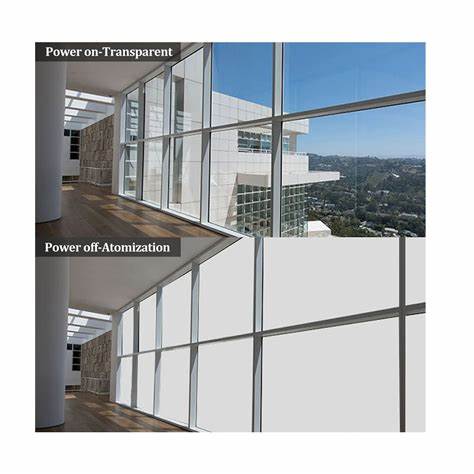
Yes. PDLC smart glass can be used outdoors when the complete glazing assembly suits the exposure. Approval should cover the glass build-up, interlayer, edge protection, frame drainage, electrical layout, solar performance, safety, testing, and maintenance as one system.
Standard self-adhesive smart film on the weather-facing side is a different product. Rain, standing water, UV, cleaners, and temperature cycling can reach its edges and busbars. For fully exposed windows, façades, doors, balcony enclosures, and skylights, factory laminated PDLC smart glass is normally the better starting point.
Quick Decision: What Does Outdoor Mean on Your Project?
Many specification errors begin because "outdoor" is used for three different conditions. Define the exposure before asking a PDLC smart glass manufacturer for a quotation.
|
Exposure condition |
Typical example |
Recommended direction |
|
Interior side of an exterior window |
Film faces the room and remains dry |
Approved self-adhesive film may be considered if the supplier accepts the temperature and sunlight exposure. |
|
Sheltered or semi-exposed area |
Covered patio, recessed entrance, enclosed balcony |
Assess splash water, condensation, cleaning, frame drainage, and edge protection. Laminated glass is usually the safer route. |
|
Fully weather-exposed glazing |
Façade, external door, rooflight, exposed balcony panel |
Use a project-specific laminated or insulated glass construction with protected edges and engineered electrical components. |
1. Specify Laminated Smart Glass, Not an Exposed Retrofit Film
Outdoor PDLC Smart Film should be protected inside a laminated glass assembly. A typical concept places the PDLC film between compatible interlayers and two glass lites. The final build-up may then be used as part of an insulated glass unit when the project also needs thermal insulation or a particular solar performance. The exact glass thickness, interlayer grade, film position, and cavity design must be confirmed for the panel size, wind load, support condition, and local code.
Do not copy an interior partition build-up. Exterior glass may need heat-treated glass, thicker lites, a different interlayer thickness, or an IGU. E&N HONJIA lists common EVA thicknesses of 0.38 mm and 0.76 mm, with thicker structures considered for demanding work. These are selection ranges, not project approval.
Smart Glass (Switchable Privacy Glass)
2. Treat Moisture Protection as a System
PDLC edges, busbars, and wire exits are the most sensitive areas. Water entry can contribute to edge whitening, bubbles, delamination, corrosion, leakage current, or loss of switching. A bead of sealant added after installation does not correct a poor frame or an incompatible material combination.
Ask how water is kept away from the laminate edge and electrical connection. Review the frame weep path, setting blocks, gaskets, wire exit, drainage direction, and any IGU secondary seal. Test the selected sealant with the actual PDLC, interlayer, edge tape, and spacer materials.
3. Check UV Stability, Temperature, and Optical Change
A temperature range on a film data sheet does not describe the complete window. Dark frames, low-emissivity coatings, sealed cavities, orientation, altitude, and local climate can raise the temperature at the glass edge or electrical connection. Request the test conditions, sample construction, duration, and acceptance criteria behind any temperature or UV claim.
E&N HONJIA lists typical values for its PDLC lamination film of about 70% powered transmission, 4.5% powered haze, 92% unpowered haze, AC 36 V operation, roughly 3 W/m² power consumption, and an operating range of minus 20°C to plus 100°C. It also lists more than 99% UV blocking when unpowered. Confirm these values for the approved model and finished glass.
Outdoor review should include changes after UV aging, humidity exposure, and thermal cycling. Compare powered transmission, haze, color, switching consistency, edge appearance, and electrical insulation before and after testing. An accelerated test supports product comparison. It does not by itself predict an exact number of service years in every climate.
4. Do Not Confuse Privacy with Solar Heat Control
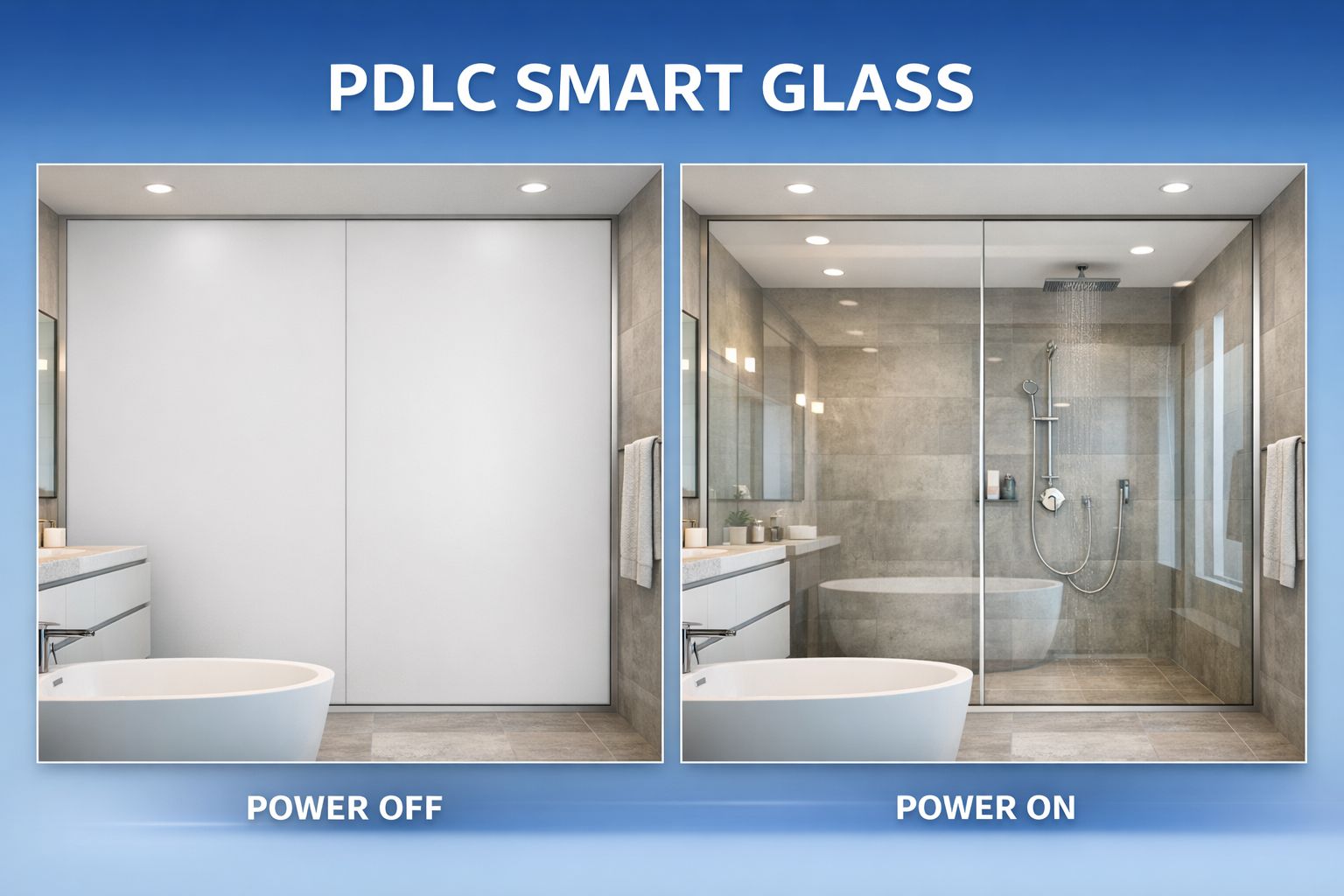
PDLC creates privacy by scattering visible light. It does not automatically provide the solar heat gain performance expected from solar control glass. A frosted appearance can reduce direct visibility and glare while infrared energy still enters the building. This matters on west-facing façades, roof glazing, and warm-climate projects where cooling load is part of the design brief.
If the project has a U-value, solar heat gain, or infrared target, request data for the complete glazing make-up. The solution may combine PDLC laminated glass with a suitable coating, tinted glass, or an insulated cavity. Review coating position and compatibility before production.
5. Design the Electrical System Before Glass Production
Busbar position, wire exit, cable route, transformer location, switching zones, and control logic affect both appearance and maintenance. They should be fixed on approved shop drawings before cutting the PDLC film. Moving a cable after lamination is rarely a clean correction.
Match transformer output to the selected product. E&N HONJIA publishes AC 36 V for its lamination film and AC 48 to 65 V for certain finished glass configurations. The wrong supply can impair performance or cause damage. Keep transformers accessible, ventilated, and protected from heat and moisture. Specify enclosure protection using IEC 60529 and follow local electrical rules. The glass edge and busbar still need separate protection.
6. Confirm Glass Safety and Structural Compliance
PDLC performance does not replace architectural glazing checks. Confirm safety glass construction, edge quality, heat treatment, wind load, supports, and breakage behavior. ASTM C1172 covers laminated architectural flat glass quality. EN 14449 and EN 12150 may apply in European markets. Local façade, guard, overhead, hurricane, fire, and impact rules can add requirements.
Ask which requirement applies to the finished glass, not only to an individual raw material. A film certificate cannot demonstrate the structural capacity of a large panel. For railings, canopies, rooflights, and other safety-critical locations, a façade consultant or structural engineer should confirm the build-up and fixing system.
7. Approve a Full-Size Sample and a Test Plan
Small swatches show color and switching, but not edge finish, wire routing, glass distortion, or large-panel uniformity. Before production, approve a representative full-size sample using the intended glass, interlayer, busbar, wire exit, edge treatment, sealant, and frame interface.
Record powered and unpowered appearance, transmission, haze, switching time, current draw, insulation, edge quality, bubbles, contamination, and tolerances. Demanding projects may also require UV, humidity, thermal cycling, boil or bake, sealant compatibility, and repeated switching tests. Record the sample build-up and batch number for traceability.
A Factory Lesson: Start with the Exposure, Not the Film Roll
From E&N HONJIA factory perspective, a recurring problem is receiving an "outdoor smart film" request with no frame section, climate information, wire exit, or drainage detail. The initial question is often about price per square metre, yet the failure risk sits at the edge and in the electrical route. When I review such an enquiry, I first separate an indoor-facing retrofit from a weather-exposed assembly. I then ask for the glass size, orientation, local temperature and humidity, frame drawing, sealant, cable route, and control voltage.
For rain or condensation exposure, we move toward laminated glass and a full-size trial. We check cleaning, storage, vacuum stability, heating, edge bonding, optical uniformity, and insulation. If bubbles or whitening appear, we review contamination, moisture, vacuum time, vacuum level, and the lamination curve before repeating the sample. The purchase then becomes a glazing system review, not a film order.
8. Plan Installation, Commissioning, and Maintenance
Outdoor durability can be lost during installation. Protect laminate edges from tools, standing water, incompatible cleaners, and site-applied materials that were not part of the compatibility review. Keep transformers and junctions accessible. Label circuits and switching zones. Commission every panel in both states, record voltage and current, inspect the busbar area, and photograph the completed edge condition before covers are closed.
State approved cleaners, inspection intervals, drainage checks, and responses to sealant damage, condensation, flicker, slow switching, or local haze. Inspect after the first severe weather period. A written process helps distinguish glazing faults from controller, wiring, or power-supply issues.
Outdoor PDLC Approval Checklist
- Exposure category and installation surface are clearly defined.
- The PDLC product is approved for the stated temperature, humidity, and UV conditions.
- The finished laminated glass or IGU build-up is shown on approved drawings.
- Glass safety, wind load, support, and local code requirements are confirmed.
- Edges, busbars, wire exits, frame drainage, and sealants are coordinated.
- Solar and thermal targets are verified for the complete glazing assembly.
- Transformer voltage, zoning, cable route, enclosure protection, and maintenance access are documented.
- A representative sample and project test plan are approved before production.
- Installation and commissioning records are included in the handover package.
Common Mistakes to Avoid
- Installing ordinary self-adhesive film on the weather-facing surface.
- Selecting glass from the PDLC film data sheet without checking the full assembly.
- Assuming a high UV-blocking figure also proves solar heat rejection.
- Leaving busbar and transformer decisions until after glass production.
- Using an untested sealant or blocking the frame drainage path.
- Treating accelerated aging as a universal outdoor life guarantee.
FAQ
Q1. Can self-adhesive PDLC smart film go on an exterior window?
A: It may be suitable on the dry interior surface of an exterior window when the manufacturer approves the sunlight and temperature exposure. It should not be assumed suitable for the weather-facing surface. Fully exposed applications normally call for a laminated, protected construction.
Q2. Does PDLC smart glass block heat?
A: PDLC mainly manages privacy and visible light scattering. Solar heat control depends on the complete glazing make-up. Request U-value and solar heat gain data when energy performance is part of the project.
Q3. Is edge sealing enough to make any PDLC film outdoor grade?
A: No. Edge protection is one part of the system. The film formulation, interlayer, glass, lamination, sealant compatibility, frame drainage, electrical design, and environmental testing must also suit the exposure.
Q4. What should be sent to a PDLC smart glass manufacturer for a quotation?
A: Send panel sizes and quantities, glass build-up, application, indoor or outdoor exposure, project location, frame section, edge coverage, wire-exit preference, control voltage, safety standard, optical targets, and required testing. Photos and drawings reduce assumptions and improve the first sample.
Conclusion
PDLC smart glass can work in outdoor-related applications when approval is based on the finished system and its evidence. E&N HONJIA supplies customizable PDLC film, laminated smart glass, EVA interlayers, and processing support. Send glass sizes, build-up, installation position, climate, frame drawing, electrical requirements, and standards. Our team can prepare a sample and test proposal before production.