Top 7 Benefits of Installing Smart Glass Film in Your Office
Glass offices look open, bright and modern, but they also create a daily problem: people need privacy at the exact moment the space is designed to be transparent. A conference room may look impressive from the reception area, but it becomes uncomfortable when HR interviews, management discussions, client negotiations or financial presentations are visible from the outside.
Smart Glass Film solves this conflict without rebuilding the office. It allows glass to change from clear to frosted on demand, so teams can keep an open-plan feeling when they want visibility and create privacy when the room is in use. For existing offices, Self-Adhesive PDLC Film can be applied to installed glass. For new projects or glass processors, PDLC Smart Film for Lamination Glass can be integrated into laminated glass panels. E&N HONJIA provides both film options, Smart Glass, Laminated Glass and accessories.
The better question is: "Which smart glass solution fits my office, budget and long-term use?" The seven benefits below answer that question from the user's point of view.
1. Instant Privacy for Meetings and Confidential Work
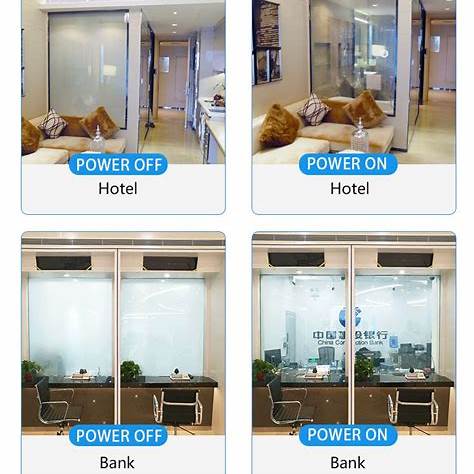
The main reason offices install Smart Glass Film is privacy on demand. In transparent mode, glass partitions keep the office open and connected. In frosted mode, PDLC Smart Film reduces visibility into the room while still allowing light to pass through.
This is useful for conference rooms, executive offices, HR interview rooms, finance departments, legal teams and client consultation areas. Traditional privacy solutions usually force a compromise. Blinds and curtains block views, but they also make the room feel closed and require manual operation. Frosted film gives privacy, but it is permanent. Smart Glass Film gives the same room two modes: open when empty, private when occupied.
2. Better Balance Between Natural Light and Visual Control
A common mistake in office design is treating privacy and daylight as opposite goals. Smart Glass Film helps solve this by creating visual privacy without turning a glass office into a closed box.
Building-energy research shows why this matters. The U.S. Department of Energy states that windows are responsible for about 10% of energy use in buildings and influence end uses that make up about 40% of building energy use. It also identifies dynamic solar control, daylighting and shading as key areas for better window performance. For offices, glass is not just a design material. It affects comfort, lighting and how people use space.
3. A Cleaner Alternative to Blinds, Curtains and Permanent Frosted Film
Open-plan offices use glass because it communicates transparency and professionalism. But when blinds are added to every meeting room, the design can quickly look cluttered. Fabric curtains collect dust. Manual blinds bend, break or stay half-open because no one adjusts them properly.
Smart Glass Film offers a cleaner appearance. It sits directly on glass or inside laminated glass, so the office keeps a minimalist, high-end look. The glass can be controlled by a switch, remote or smart control system. This is especially important for client-facing meeting rooms, showrooms, law firm consultation rooms and technology company boardrooms.
4. Retrofit Existing Office Glass Without Full Replacement
Many office users do not want to remove existing glass partitions. They have already invested in the fit-out, and replacing glass panels can interrupt work, increase cost and extend project schedules.
For this situation, Self-Adhesive PDLC Film is usually the most practical option. E&N HONJIA describes it as a retrofit solution that can transform ordinary glass into switchable glass without lamination. Its peel-and-stick structure is designed for direct application to existing glass, making it suitable for office partitions, conference rooms, executive offices, hotels, healthcare spaces and retail displays.
Before requesting a quotation, prepare glass size, panel quantity, indoor or outdoor use, frame type, cable path, control method, photos or drawings, and whether the glass is already installed.
5. Improved Comfort Through Glare, UV and Heat Management
In glass-heavy offices, glare can make screens harder to read and direct sunlight can create uncomfortable hot spots. Smart Glass Film should not be treated as a full building energy strategy, but it can support better light and comfort management when specified correctly.
E&N HONJIA's Self-Adhesive PDLC Film has visible light transmission of about 84% in the ON state and about 5% in the OFF state, with OFF-state haze around 90%. It also lists UV blocking of more than 90% in the ON state and more than 98% in the OFF state. For PDLC Smart Film for Lamination Glass, E&N lists OFF-state haze around 92%, UV blocking above 99% in the OFF state, AC 36V operating voltage and power consumption around 3 W/m².
These numbers matter because buyers need more than a visual demonstration. A high-quality PDLC Smart Film should be evaluated by measurable performance, not just by whether it "turns frosted."
6. Multi-Functional Meeting Rooms
An office room is rarely used for only one purpose. The same glass-walled space may support meetings, video calls, training, client presentations and brainstorming. When Smart Glass Film is frosted, the glass surface can also work as a projection background in many commercial layouts. In some rooms, it can support writing or visual collaboration when paired with suitable markers and cleaning practices.
For users, this creates better return from the same square meters because one glass space can adapt to different work modes throughout the day.
7. A Smarter Procurement Path for Laminated Glass Projects
Not every project should use self-adhesive film. If the office is being built from the beginning, or if a glass processor is manufacturing finished panels, Laminated Smart Glass may be the better solution.
E&N HONJIA's PDLC Smart Film for Lamination Glass is a non-adhesive smart film designed for laminated glass processing. It can be integrated into glass panels through autoclave or vacuum lamination. The finished Smart Glass structure places PDLC film between two pieces of glass, creating a more integrated product for long-term architectural use.
The important point is choice. Existing office glass usually calls for Self-Adhesive PDLC Film. New construction or factory glass processing may call for PDLC Smart Film for Lamination Glass or finished Smart Glass.
Smart Glass Film vs Laminated Smart Glass vs Traditional Options
| Option | Best for | Main advantage | Limitation |
|---|---|---|---|
| Self-Adhesive PDLC Film | Existing office partitions and windows | Fast retrofit without replacing glass | Requires careful surface preparation and wiring |
| PDLC Smart Film for Lamination Glass | Glass processors and new projects | Built into laminated glass during processing | Requires lamination equipment |
| Finished Smart Glass | High-end office projects | Integrated switchable laminated glass system | Higher project cost and custom production |
| Frosted Film | Permanent privacy areas | Low cost | Cannot switch back to clear |
| Blinds or Curtains | Low-budget privacy | Familiar and simple | Dust, maintenance and visual clutter |
| Standard Glass Partition | Open office design | Bright and transparent | No privacy control |
Common Misunderstandings Before Buying Smart Glass Film
Smart Glass Film is not blackout glass. PDLC Smart Film creates privacy by scattering light; it becomes frosted and reduces visibility, but light can still pass through.
Not all smart films perform the same. Buyers should compare visible light transmission, haze, UV blocking, switching time, voltage, power consumption, roll size, expected service life and supplier support.
The cheapest film is not always the best value. A lower price can become expensive if the film has poor clarity, uneven haze, unstable edges or weak after-sales support. For procurement, sample testing is more reliable than comparing price per square meter alone.
How to Choose the Right PDLC Smart Film for Your Office
Start with the user scenario. If the goal is to upgrade an existing meeting room, choose Self-Adhesive PDLC Film. If the goal is to produce laminated smart glass panels, choose PDLC Smart Film for Lamination Glass. If the project requires finished panels, consider Smart Glass or Laminated Glass solutions.
Then check performance data. For office applications, prioritize high ON-state clarity, high OFF-state haze, safe operating voltage, low power consumption, strong UV protection, suitable roll width, reliable accessories and technical support for installation or lamination.
Finally, ask for samples. A professional buyer should test transparency, frosted uniformity, edge quality and controller compatibility before placing a bulk order.
Why Source PDLC Smart Film from E&N HONJIA?
E&N HONJIA is positioned for buyers who need more than a single smart film roll. Its product range includes Self-Adhesive PDLC Film, PDLC Smart Film for Lamination Glass, Smart Glass, Laminated Glass and accessories such as power supplies. This wider product system is useful for offices, contractors and glass processors because one project may require film, laminated glass knowledge, power control and processing support at the same time.
For procurement teams, this reduces uncertainty. Buyers can discuss the complete application: office layout, glass size, installation method, control system, sample testing and delivery plan.
FAQ
Q1. Can smart glass film be installed on existing office glass?
A: Yes. Self-Adhesive PDLC Smart Film is designed for retrofitting existing glass partitions, conference rooms, executive offices, hotel bathrooms, residential windows, retail displays, and advertising panels. It can transform ordinary glass into switchable privacy glass without lamination, making it suitable for offices that want privacy control without replacing all glass panels.
Q2. What is the difference between Self-Adhesive PDLC Film and PDLC Smart Film for Lamination Glass?
A: Self-Adhesive PDLC Film is applied directly onto existing glass, while PDLC Smart Film for Lamination Glass is a non-adhesive film used inside laminated glass processing. For retrofit office projects, self-adhesive film is usually more practical. For glass factories, new construction, or finished smart glass panels, PDLC film for lamination is the better choice.
Q3. Does PDLC Smart Film make glass completely opaque?
A: No. PDLC Smart Film creates a frosted privacy effect by scattering light. It blocks visibility, but it still allows light to pass through. For example, E&N HONJIA's PDLC Smart Film for Lamination Glass lists around 5% light transmission and about 92% haze in the OFF state, which provides strong privacy while keeping the space from feeling fully closed.
Q4. Is Smart Glass Film suitable for office meeting rooms and partitions?
A: Yes. Office partitions, meeting rooms, and executive offices are among the most practical applications for Smart Glass Film. It allows rooms to stay clear and open when not in use, then switch to privacy mode during meetings, interviews, presentations, or confidential discussions. E&N HONJIA specifically lists office partitions, conference rooms, and executive offices as suitable applications for its Self-Adhesive PDLC Film.
Conclusion
Smart Glass Film is not simply a decorative upgrade. For modern offices, it solves a practical workplace problem: how to keep glass spaces open, bright and professional while giving users privacy exactly when they need it.
Use Self-Adhesive PDLC Film when you want to retrofit existing office glass. Use PDLC Smart Film for Lamination Glass when you are manufacturing laminated smart glass. Choose finished Smart Glass when the project calls for a complete switchable glass panel.
If you are planning an office partition, meeting room, executive office or laminated glass project, send your glass sizes, application photos or drawings to E&N HONJIA. The team can help recommend the right PDLC Smart Film, Laminated Glass solution and accessories for your project.