
Smart Glass Manufacturer Checklist: How to Evaluate Film, Glass, Testing and Technical Support
A smart glass sample can switch correctly on a desk and still be the wrong product for a project. The sample may use a different voltage, glass construction or edge treatment from the final order. It may also look clear under showroom lighting but show more haze when viewed across a bright office. This is why choosing a smart glass manufacturer requires more than comparing price, transparency claims and a short switching video.
For glass processors, distributors, architects and project buyers, the practical question is whether the supplier can reproduce the approved performance through production, shipment, installation and service. The checklist below focuses on the evidence that helps buyers make that decision.
1. Define the project before asking for a quotation
Start with the opening, not the product catalogue. Tell the manufacturer whether the glass already exists, whether the installation is indoors, outdoors or in a wet area, and whether the project is a retrofit or new construction. Include panel sizes, quantities, glass thickness, privacy expectations, viewing distance, control zones and local safety requirements.
Existing interior glass often points to self adhesive PDLC film because the original glazing can remain in place. New office partitions, hotel bathrooms, healthcare rooms and higher durability installations usually justify evaluating laminated smart glass, where the active film is protected inside the glass. A glass processor that wants to manufacture locally may instead need non adhesive PDLC film for lamination, plus a compatible interlayer and process guidance.
2. Confirm what the manufacturer actually supplies
A factory review should separate PDLC film production, glass processing, electrical integration and technical service. The buyer needs to know who controls each stage and who accepts responsibility if a panel fails.
A factory video is useful evidence of facilities. It does not prove that the quoted model was produced or tested there. Link the quotation, technical data sheet, sample label and test report to the same model and batch whenever possible.
3. Compare the correct product data
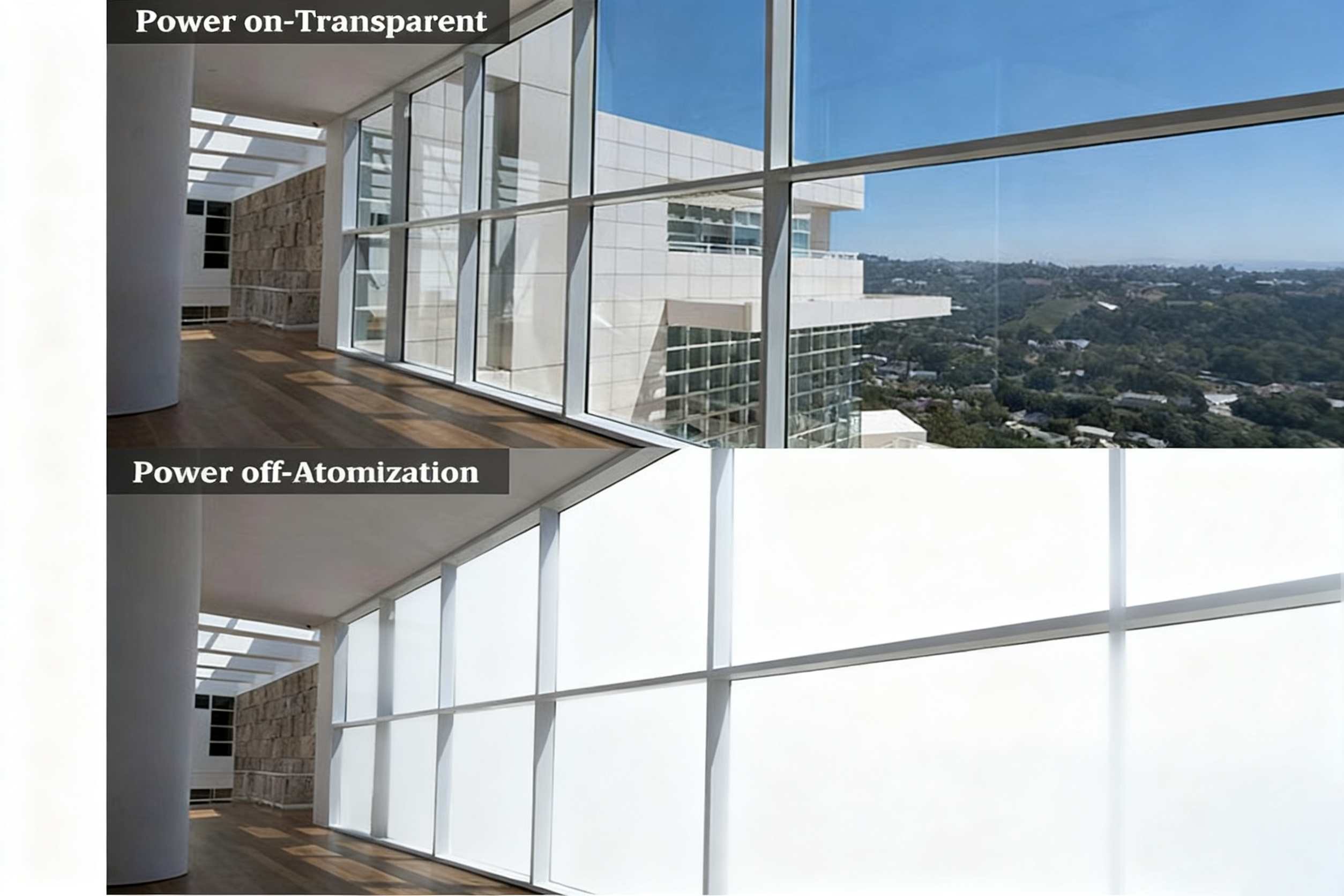
Light transmission and haze answer different questions. Light transmission indicates how much visible light passes through the material. Haze describes how much transmitted light is scattered, which affects perceived clarity. ASTM D1003 is a recognized method for measuring haze and luminous transmittance in transparent plastics, but a number is only comparable when the sample construction and test conditions are stated.
E&N HONJIA publishes different typical values for different PDLC configurations. They should not be mixed into one generic smart glass specification.
|
Product |
Published typical values |
Buyer use |
|
PDLC film for lamination |
ON transmission about 70%; OFF transmission about 5%; ON haze about 4.5%; OFF haze about 92%; AC 36 V; about 3 W/m²; 0.30 mm film |
Local glass lamination and OEM processing |
|
Self adhesive PDLC film |
ON transmission about 84%; OFF transmission about 5%; OFF haze about 90%; stated indoor life above 50,000 hours |
Retrofit on suitable existing interior glass |
|
Finished switchable glass |
Up to 90% ON transparency; OFF haze above 95%; AC 48 to 65 V; about 4 to 5 W/m²; switching below 0.2 seconds; sizes up to 1800 × 3500 mm |
New or replacement glazing supplied as a completed panel |
View samples straight on and from the angles people will use in the finished room. Test clear state haze against both dark and bright backgrounds. For privacy, place a person or object behind the panel under strong backlighting. PDLC produces a frosted state rather than a black screen, so privacy should be judged by the visibility of shapes and details under the intended lighting.
4. Test a system, not just a piece of film
A small sample is suitable for initial comparison. A project approval should go further. Build a representative mock up using the actual glass, interlayer, framing approach, edge protection, busbar position, wire exit and power supply. Use the same room lighting and viewing distance expected on site.
Our project review starts by checking application and glass structure before discussing square metres. We then compare the sample under consistent power, lighting and viewing conditions. For lamination projects, the sample should include the proposed EVA, PDLC film, conductors and edge detail. Only after the optical appearance, switching uniformity and electrical arrangement are reviewed should the configuration move into production approval.
Record the model, batch, surface condition, clear state appearance, frosted uniformity, backlit privacy, voltage, power draw, busbar quality and repeated cycling. Keep the results with a signed approval sample so the buyer and factory have a reference for later batches.
5. Verify safety and test evidence
Smart glass combines optical film, laminated glazing and electrical components. A film haze report does not demonstrate finished panel impact safety, while a safety glass report does not confirm transformer compliance or switching durability.
For projects in the United States, 16 CFR Part 1201 addresses safety requirements for architectural glazing materials in defined applications. Other markets and project types may call for different safety, structural, fire or electrical requirements. The architect, engineer or authority having jurisdiction should identify the applicable standards before glass production begins.
For every report, check six details: applicant, manufacturer, exact model, sample construction, test method and report date. Also confirm the laboratory and the reported result. A certificate image without a product match is weak evidence. If a supplier states that a film, interlayer or completed glass was tested, ask whether the report applies to the same thickness, electrical system and manufacturing location as the quotation.
6. Review quality control from incoming material to shipment
Consistent production depends on controls that buyers rarely see in a finished sample. The manufacturer should inspect incoming glass, conductive film, PDLC material, interlayer and electrical components. During production, the team should control cleanliness, alignment, electrode preparation, lamination conditions and visual defects. Before shipment, each completed panel should be checked for dimensions, appearance, wiring and switching.
Ask how batches are identified and how inspection records are retained. If a panel develops black spots, local non switching areas, bubbles or edge delamination, batch records help separate material, processing, electrical and installation causes. A useful corrective action report explains the defect, containment action, root cause, replacement decision and prevention step rather than simply promising a new panel.
7. Evaluate electrical and technical support
Technical support should begin before the purchase order. The supplier should be able to review drawings, panel dimensions, busbar orientation, wire exits, control zones and transformer loading. Installers need guidance on approved sealants, cable routing, ventilation around power supplies and preinstallation testing.
Ask who answers technical questions and what evidence is needed for troubleshooting. E&N HONJIA supplies PDLC film for lamination, self adhesive film, switchable glass, power supplies, EVA interlayers and lamination accessories. This can simplify compatibility discussions, but processors should still request current guidance and run a trial for the selected model, glass structure and equipment.
8. Compare warranty scope and total project cost
Warranty length alone is not enough. Separate coverage for PDLC material, glass processing, power supply and installation. Read the exclusions for incorrect voltage, unapproved sealants, moisture exposure, physical damage, outdoor use and improper cleaning. Confirm who pays for freight, removal, reinstallation and site labor.
Compare quotations on the same model, panel build up, controls, documentation, delivery and warranty scope. Total project cost includes material, processing, shipping, installation, maintenance and potential replacement. A higher initial price may be reasonable when it comes with clearer evidence, batch control and usable engineering support.
Common mistakes buyers can avoid
Do not approve an order from a switching video alone. Do not compare self adhesive film with finished laminated glass as if they are the same product. Do not accept a test report until its model and sample structure match the quotation. Do not assume a published typical value is a guaranteed limit. Do not leave wire exits, transformer capacity, sealant and framing decisions until installation.
An office retrofit, a hotel bathroom and a glass processor trial have different risks. The checklist must connect product selection, evidence and support to the actual opening.
Questions to ask before placing an order
- What part of the film, glass and electrical system do you manufacture?
- Which exact model and glass build up are included in the quotation?
- Can the test reports be matched to that model and construction?
- What sample and mock up process do you recommend?
- How are batches tested and traced?
- Who reviews drawings, wiring and transformer loading?
- What does the warranty cover, exclude and require from the buyer?
- What happens if a panel fails after installation?
Conclusion
A reliable smart glass manufacturer should be able to connect five things: the correct product for the application, measurable optical and electrical data, a representative sample, traceable production control and technical support that continues through installation. When those pieces agree, buyers have a clearer basis for comparing suppliers and approving a project.
If you are evaluating PDLC film for local lamination, a self adhesive retrofit or completed switchable glass, send the glass structure, sizes, quantity, application and destination market for technical review. A useful quotation should begin with those details, not only a request for total square metres.