Smart Glass for Office Partitions: Privacy, Wiring and Glass Selection
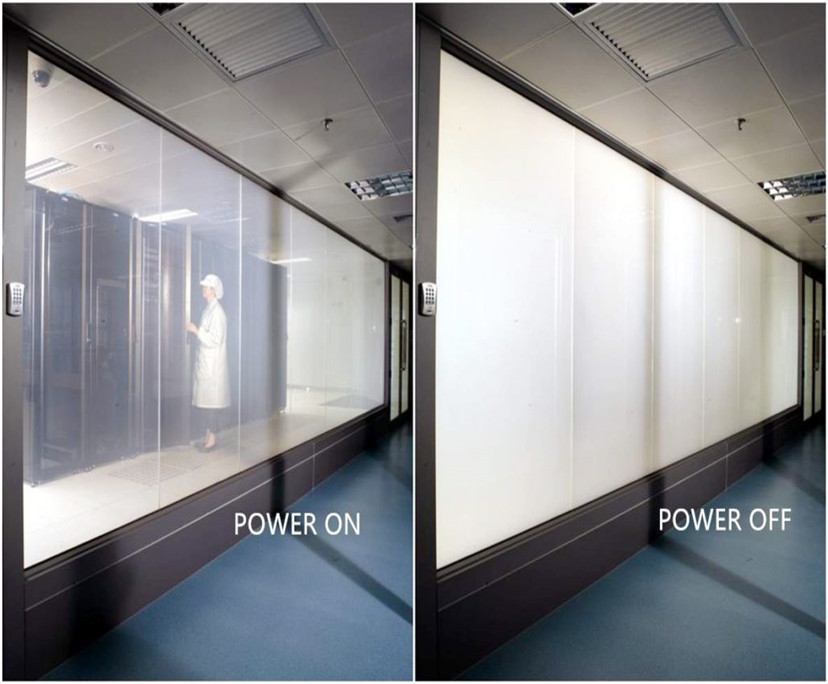
Office partitions need to perform two jobs that often conflict. They should keep a workplace open and well lit, but they must also provide privacy when a meeting, interview or confidential discussion begins. Smart Glass for Office applications addresses this problem by changing from transparent to a frosted privacy state with electrical control.
For a new partition, the most important decision is not simply whether the glass can switch. The project team must also confirm the wiring route, control zones, glass structure, safety requirements and the difference between laminated Smart Glass and retrofit smart film. E&N supplies PDLC Smart Film, finished Smart Switchable Glass, EVA interlayers and SGP interlayers for these applications.
Why offices choose Smart Glass partitions
A transparent meeting room can make an office feel larger and brighter. It also allows daylight to move through the space and supports a more open visual connection between teams. The same transparency becomes a problem when people need privacy.
PDLC Smart Glass changes this balance without curtains or blinds. When the power is on, the glass is transparent. When the power is off, the PDLC layer scatters light and the glass appears frosted. People outside can still see light and movement, but clear facial details and documents are difficult to identify.
Common office uses include:
- Meeting and conference rooms
- Executive offices
- Human resources interview rooms
- Finance and legal consultation rooms
- Training rooms with flexible layouts
- Reception areas and client briefing rooms
- Glass doors and internal office fronts
Smart Glass provides visual privacy. It should not be described as a complete acoustic or thermal solution unless the entire partition system has been tested for those properties.
How PDLC Smart Glass creates instant privacy
PDLC means Polymer Dispersed Liquid Crystal. In a laminated panel, the PDLC film is placed between two glass sheets with an interlayer. E&N's finished Smart Glass uses a structure based on glass, EVA, PDLC film, EVA and glass.
When electricity is applied, liquid crystal molecules align and allow light to pass through more directly. The panel becomes transparent. When the power is removed, the molecules return to a random arrangement. Light is scattered and the panel becomes opaque or frosted.
The switching response is fast enough for normal office use. E&N lists a switching time below 0.2 seconds for its Smart Glass, with transparency up to 90 percent when powered and haze above 95 percent when unpowered. The exact result depends on glass thickness, film specification, panel size and test conditions. Buyers should request the current technical data sheet for the production batch.
The frosted state is not the same as a black-out blind. It reduces direct visibility while still allowing diffused light to enter the room. This is useful when a meeting room needs privacy without becoming dark.
Wiring should be planned before the partition is ordered
Most installation problems begin when electrical planning is left until the glass has already been manufactured. A clean project normally follows this path:
Building power supply → transformer or power adapter → control panel → partition cable → PDLC glass
The electrical contractor, partition supplier and glass manufacturer should confirm the following items during the design stage.
Power supply and transformer location
E&N's finished Smart Glass specification lists AC 48 to 65 volts and power consumption of approximately 4 to 5 watts per square metre. Other PDLC film products can use different voltages, so the transformer must match the exact product. A power supply designed for another film type should not be substituted.
The transformer may be located above the ceiling, inside a service cabinet or beside the partition. It needs ventilation, service access and clear identification. Hiding the transformer in a sealed frame can make future maintenance difficult.
Cable route and frame depth
Each panel requires a connection from the PDLC busbar to the control system. The cable may be routed through the partition frame, ceiling cavity or adjacent wall. Very narrow profiles may not provide enough room for a protected cable path.
The frame supplier should confirm:
- Cable channel dimensions
- Entry and exit points
- Minimum bending radius
- Protection from sharp metal edges
- Access for replacement or inspection
For frameless systems, the cable route must be coordinated with the floor channel, ceiling detail or a concealed vertical chase.
Control zones
A small meeting room may use one wall switch for the complete partition. A larger office often needs several zones. For example, the conference room door, front wall and side panels may require separate control.
Possible control methods include:
- Wall switch
- Touch panel
- Remote control
- Mobile application
- Motion or occupancy sensor
- Timer
- Building management system
The control schedule should identify which switch controls each glass panel. This prevents confusion after handover and makes troubleshooting faster.
Doors, corners and movable panels
Glass doors require special attention because the panel moves and the cable must remain protected. Sliding or folding partitions may require a different connection method from fixed panels. Corner joints also need enough space for the busbar and cable exit.
Before production, provide the manufacturer with the partition elevation, glass numbering, door locations, frame sections and intended control zones. A simple wiring diagram can prevent expensive changes on site.
Choosing the right glass solution
There are three practical routes for an office project.
| Solution | Best suited to | Main advantage | Key consideration |
|---|---|---|---|
| Laminated PDLC Smart Glass | New partitions and premium fit-outs | Integrated appearance and protected film layer | Requires glass production and planned wiring |
| PDLC film for lamination | Glass processors and OEM projects | Flexible control of glass thickness and interlayers | Requires correct lamination process |
| Self-Adhesive PDLC Film | Existing glass renovation | Applies directly to installed glass | Existing glass condition and edge protection are critical |
Laminated PDLC Smart Glass for new construction
Finished Smart Glass is generally suitable when the partition is being built from new glass. The PDLC layer is protected inside the laminated structure, and the panel is installed as a complete glazing product.
E&N lists 5+5 mm, 6+6 mm and custom glass thicknesses, with a maximum reference size of up to 1800 by 3500 mm. Actual maximum dimensions depend on transport, glass processing equipment, frame support and project safety requirements.
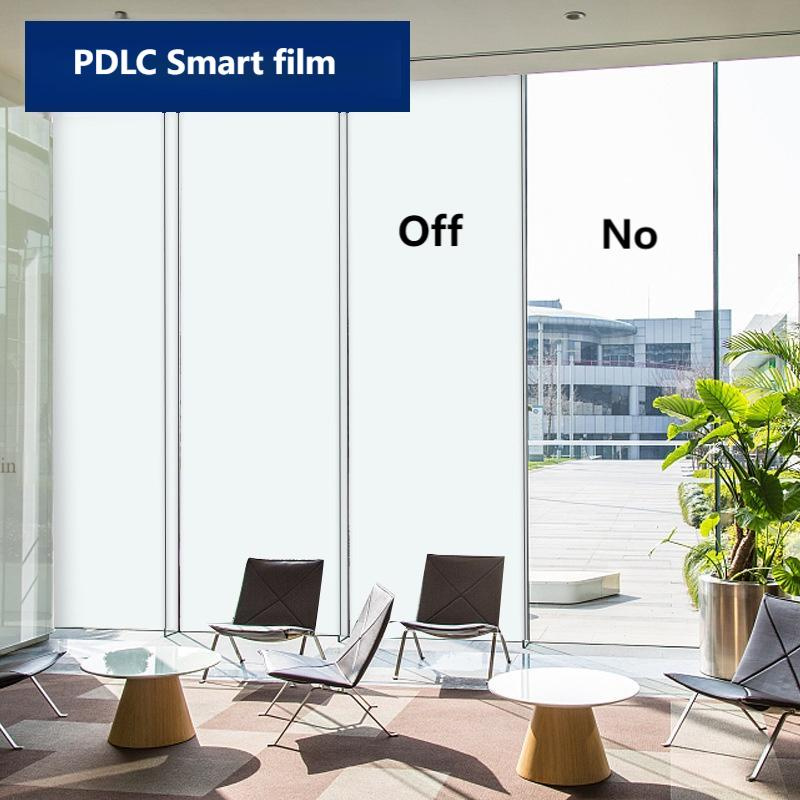
PDLC Smart Film For Lamination Glass
PDLC film for lamination
Non-adhesive PDLC film is designed to be laminated between glass sheets. This option is useful for glass factories and project suppliers that need to control the glass build-up, edge finishing and interlayer selection.
EVA is important because it bonds the glass and protects the functional film. E&N supplies clear EVA interlayers and other EVA options for laminated glass processing. The lamination cycle, temperature, vacuum level and edge sealing method should follow the approved process for the selected film.
Self-Adhesive PDLC Film for retrofit
When an office already has glass partitions, replacing every panel may interrupt work and increase cost. E&N’s Self-Adhesive PDLC Film is designed for direct application to existing glass. The product page lists approximately 80 percent visible transmission in the powered state, around 5 percent transmission in the unpowered state, about 90 percent off-state haze, AC 60V operation and power consumption of approximately 6 W/m².
Before choosing retrofit film, check whether the existing glass is flat, clean, undamaged and suitable for film application. The film does not automatically change the safety classification, fire rating or acoustic rating of the original partition.
Safety, acoustic and fire requirements
For high-traffic offices, safety glass selection should be based on the complete laminated structure. The project team should confirm glass type, thickness, edge treatment, frame support and door hardware.
ASTM C1172 is commonly referenced for architectural laminated glass quality. In the United States, safety glazing requirements may also fall under 16 CFR Part 1201. Other markets have their own requirements, so the architect and contractor should confirm the applicable local standard.
Acoustic performance must be tested as a system. A claim about the PDLC film alone does not establish the sound reduction of the finished partition. Frame seals, doors, ceiling connections, floor channels and adjacent walls can have a larger influence on speech privacy than the film layer.
Fire-rated performance should also be confirmed at system level. A PDLC film should not be presented as fire-rated unless the complete glass and framing assembly has the required test documentation.
Factory experience: what we check before production
From our factory project support experience, the most common cause of rework is incomplete information rather than a problem with the switching technology. We first check the glass schedule, panel dimensions, cable direction and control zones. We then match the power supply to the exact PDLC specification and confirm whether the project uses finished Smart Glass or film for lamination.
During production, our checks focus on film alignment, EVA bonding, edge condition and electrical connection. Each panel should be tested in both transparent and frosted states before packing. The glass number, cable location and control zone should be recorded so the installer can connect the partition without guessing.
This process is especially important for large panels, glass doors and partitions with several independent control areas.
Information needed for an accurate quotation
A Smart Glass Manufacturer can prepare a more reliable proposal when the buyer provides:
- Glass width, height and thickness
- Quantity and panel numbering
- New construction or retrofit status
- Fixed, sliding or door application
- Indoor or outdoor environment
- Preferred control method
- Number of control zones
- Frame profile or partition drawing
- Safety, acoustic or fire requirements
- Destination country and delivery schedule
E&N can support projects involving PDLC Smart Glass, PDLC film for lamination, Self-Adhesive PDLC Film, EVA interlayers and SGP interlayers. Share the glass schedule, drawings or site photographs to receive a product and wiring recommendation based on the actual office partition.
FAQ
Q1. Does Smart Glass for Office partitions need electricity?
A: Yes. PDLC glass requires a compatible low-voltage power supply and controller to switch between transparent and frosted states.
Q2. Is the glass transparent when power is off?
A: For standard PDLC privacy glass, the unpowered state is normally frosted. Always confirm the fail-safe state in the product specification.
Q3. Can existing office glass be upgraded?
A: Yes. Self-Adhesive PDLC Film can be applied to suitable existing glass. The original glass condition and edge protection must be checked first.
Q4. Does PDLC Smart Glass block sound?
A: The laminated structure may contribute to acoustic performance, but the result depends on the complete partition. Request system-level acoustic test data for projects with strict speech privacy requirements.
Q5. Can Smart Glass become a projection screen?
A: The frosted state can support rear projection. Performance depends on haze, projector brightness, ambient light, panel size and viewing distance. Test a sample when projection is important.
Q6. How should a buyer compare manufacturers?
A: Compare verified specifications, sample results, lamination support, wiring documents, control compatibility, packaging, warranty terms and the manufacturer's ability to answer project-specific questions.
Smart Glass works best when privacy, electrical planning and glass engineering are considered together. With the correct structure and early coordination, an office partition can remain open during normal work and become private within a fraction of a second when the room is needed.
Conclusion
Smart glass for office partitions delivers privacy while preserving daylight. Compare laminated PDLC glass with retrofit film, plan transformers and control zones, verify safety, acoustic and fire requirements, select a manufacturer for installation.