
Smart Glass for Hotel Bathrooms and Guest Rooms: Design and Installation Considerations
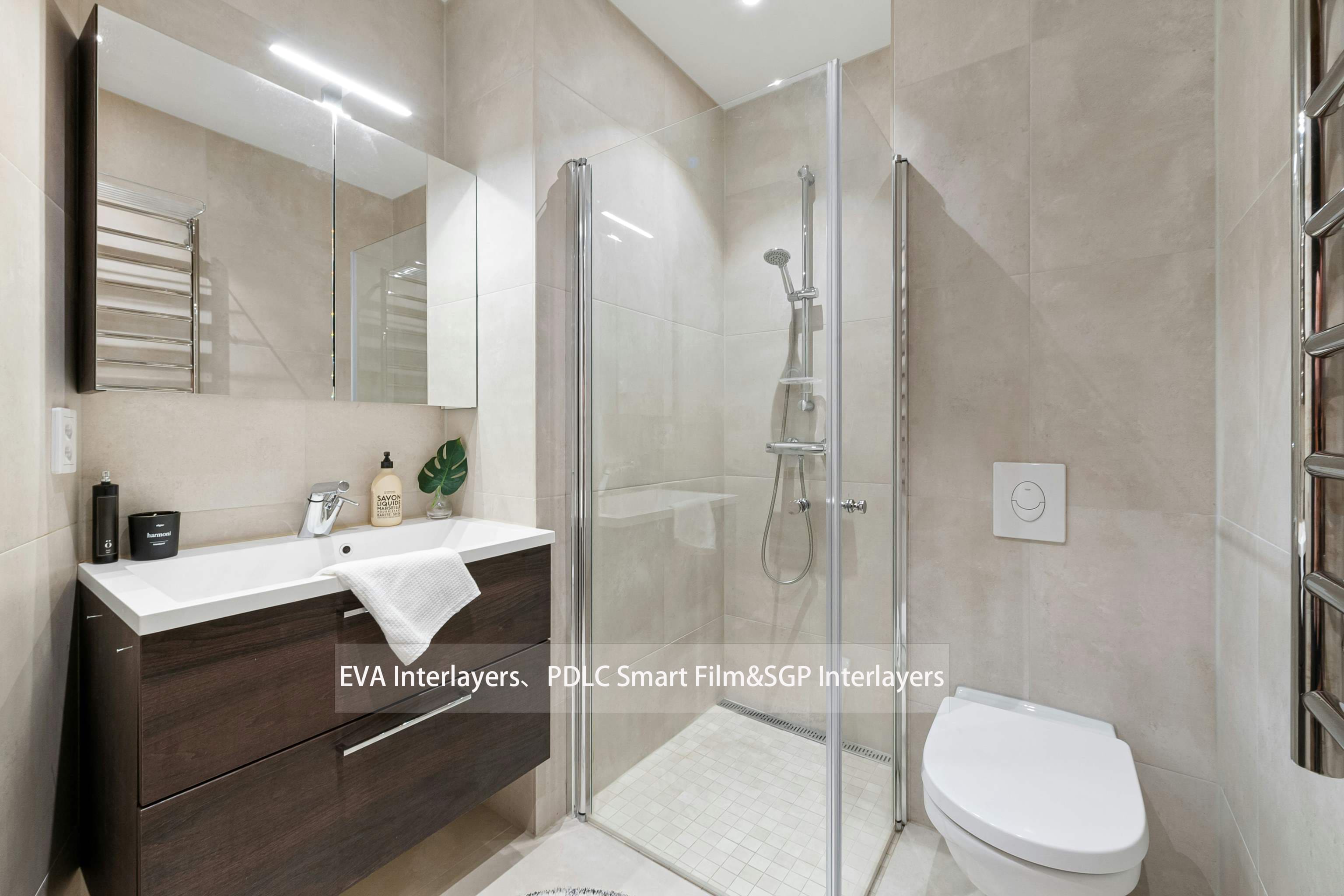
Smart Glass gives hotels a way to create open, light-filled bathrooms without giving up guest privacy. A glass wall between the bedroom and bathroom can make a compact room feel larger, bring daylight deeper into the plan and create a distinctive design feature. When privacy is needed, the same glass can change to a frosted state at the touch of a button.
The visual effect is simple for a guest, but a successful hotel installation requires careful decisions about glass construction, controls, lighting, moisture, wiring and maintenance. E&N supplies PDLC Smart Glass, PDLC film for lamination, Self-Adhesive PDLC Film, EVA interlayers and SGP interlayers for hospitality and architectural applications.
Why hotels use Smart Glass in bathrooms and guest rooms
Traditional solid walls separate the bathroom from the sleeping area, but they also reduce daylight and make a small room feel enclosed. Curtains and blinds provide privacy, yet they collect dust, require hardware and can look out of place in a modern suite. Permanent frosted glass protects privacy but removes the option of a clear view.
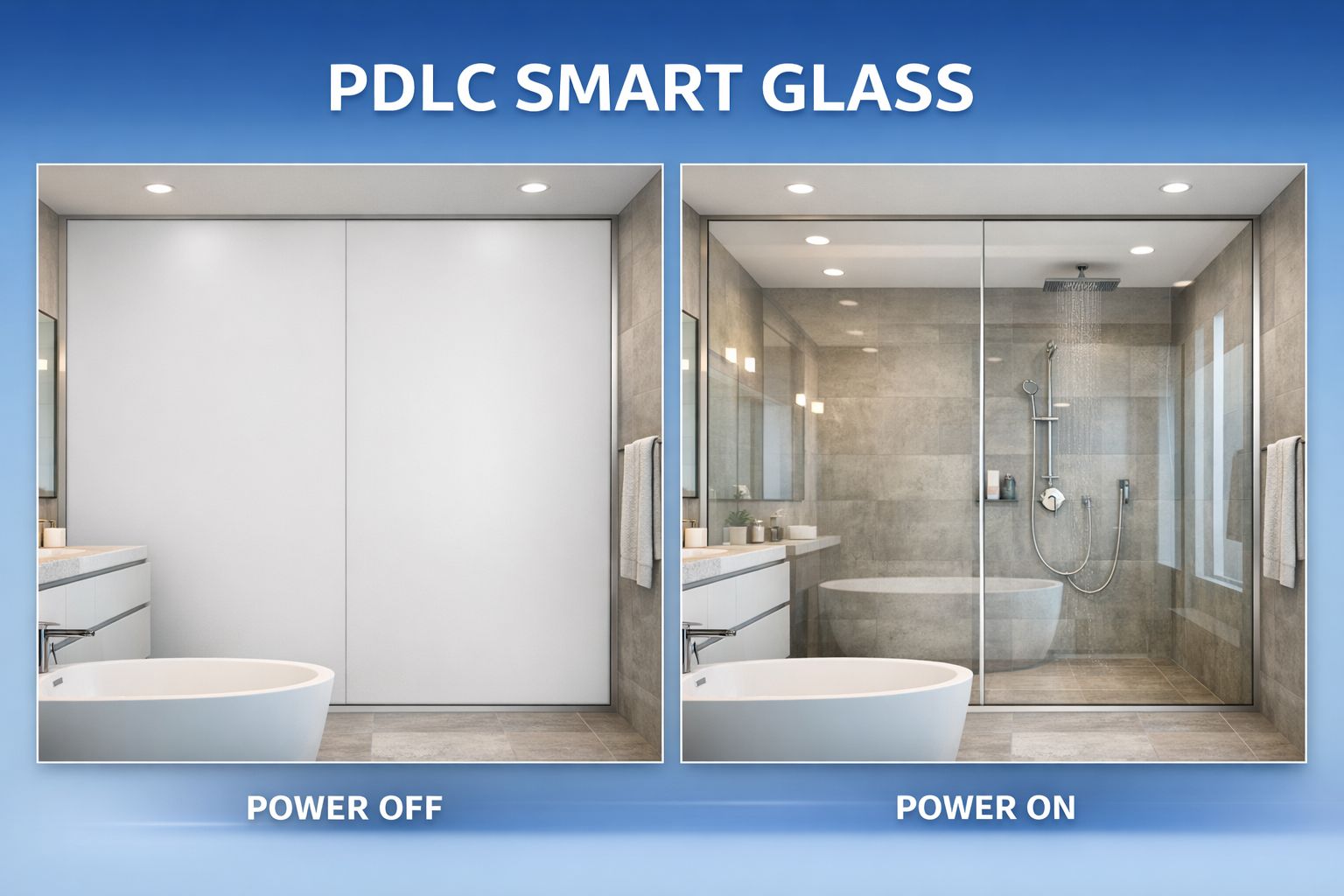
PDLC Smart Glass addresses these competing requirements. In the powered state, the glass is transparent and the room feels visually connected. When the power is removed, the PDLC layer scatters light and the glass appears frosted. The bathroom still receives soft light, but clear views are reduced.
Typical hospitality applications include:
- Guest room bathroom partitions
- Shower and bathtub screens
- Suite bedroom dividers
- Bathroom doors
- Spa treatment rooms
- Hotel meeting rooms
- Flexible event spaces
- Reception and display areas
The main benefit is visual privacy on demand. Smart Glass should not be described as a complete soundproofing, fire-rated or waterproof solution unless the entire glazing and framing system has been tested for those requirements.
How PDLC Smart Glass works
PDLC means Polymer Dispersed Liquid Crystal. In a finished laminated panel, the active film is placed between two sheets of glass. E&N's Smart Glass uses a structure based on: Glass + PDLC Film + Glass
When power is applied, liquid crystal molecules align and allow light to pass through more directly. The panel becomes transparent. When power is removed, the molecules become randomly oriented and scatter light, creating a frosted appearance.
E&N lists transparency of up to 90 percent in the powered state, haze above 95 percent in the unpowered state, switching in less than 0.2 seconds, power consumption of approximately 4 to 5 W/m² and UV blocking above 99 percent. These are product reference values. The final result depends on glass thickness, panel size, film specification, lighting conditions and test methods.
The frosted state is designed to reduce clear visibility, not to create total blackout. Guests may still see diffused light and indistinct movement. For a bathroom, this distinction matters because privacy expectations vary between a shower area, a vanity and a toilet compartment.
Design considerations for hotel bathrooms
Place controls where guests can use them naturally
A guest should not need a mobile application or a technical explanation to operate bathroom privacy glass. A clearly marked switch near the bed and another switch near the bathroom entrance are often the most intuitive arrangement.
For larger suites, the design team may choose:
- Bedside control
- Bathroom entrance switch
- Remote control
- Touch panel
- Room management system integration
- Occupancy or door sensor
- Timer function
The control logic should be agreed before production. Decide whether the entire bathroom partition changes together or whether the door, shower screen and fixed wall operate independently.
Plan for nighttime privacy
A frosted panel can still transmit light. If the bathroom is brightly lit at night, silhouettes may become visible depending on the distance between the guest and the glass, the position of the light sources and the level of haze.
During the sample room stage, test the glass under realistic conditions:
- Bedroom lights on and bathroom lights off
- Bathroom lights on and bedroom lights off
- Both rooms illuminated
- Daylight entering from the window
- Guest standing close to the glass
- Guest standing several metres away
A lighting designer can reduce unwanted silhouettes by positioning luminaires away from the glass, using indirect light and avoiding strong backlighting directly behind the person using the bathroom.
Consider the position of the toilet
A glass wall may work well between a vanity and bedroom, but a fully transparent bathroom layout may not provide sufficient privacy around the toilet. Designers often combine Smart Glass with a short solid wall, a separate enclosed compartment or a controlled privacy zone.
The objective is not to make every surface transparent. It is to use clear glass where spatial openness creates value and switchable privacy where the guest needs control.
Coordinate glass doors with fixed panels
A bathroom door has different requirements from a fixed partition. The design must allow for movement, hardware, cable protection and a reliable connection to the PDLC layer. Sliding doors and hinged doors should be reviewed separately.
Confirm the following before ordering:
- Door type and opening direction
- Glass thickness
- Hinge or roller hardware
- Cable exit location
- Frame channel dimensions
- Bottom and top clearances
- Cleaning access
- Emergency access requirements
Laminated Smart Glass or Self-Adhesive PDLC Film?
The correct solution depends on whether the hotel is being built from new or renovated.
| Requirement | Laminated PDLC Smart Glass | Self-Adhesive PDLC Film |
|---|---|---|
| New hotel construction | Suitable | Usually unnecessary |
| Existing glass renovation | Requires glass replacement | Suitable for compatible glass |
| Film protection | Encapsulated between glass panes | Applied to glass surface |
| Appearance | Integrated and clean | Depends on original glass and edge treatment |
| Wet area use | Requires sealed laminated structure | Requires careful moisture evaluation |
| Installation time | Longer manufacturing stage | Shorter retrofit installation |
| Safety classification | Determined by complete laminated glass | Original glass rating remains unchanged |
| Best use | New bathroom partitions and premium suites | Existing room upgrades |
Laminated PDLC Smart Glass
For new guest rooms, laminated Smart Glass provides an integrated appearance and protects the active film inside the glass. E&N lists 5+5 mm, 6+6 mm and custom thickness options, with reference sizes up to 1800 × 3500 mm.
The final glass build-up should be selected according to the partition frame, door hardware, local safety rules and transportation limits. A larger panel is not automatically a better panel if the frame, floor loading or installation access cannot support it.
PDLC film for lamination
E&N's PDLC Smart Film for Lamination is intended for glass processors that manufacture finished laminated Smart Glass. The film is combined with EVA or another approved interlayer within a controlled lamination process.
Important production controls include:
- Film alignment
- Glass cleanliness
- EVA compatibility
- Vacuum and temperature settings
- Edge sealing
- Busbar protection
- Electrical testing after lamination
This route gives the processor more control over glass thickness, shape, edge finishing and project-specific construction.
Self-Adhesive PDLC Film
For hotel renovation, Self-Adhesive PDLC Film can be applied to suitable existing glass without replacing the entire panel. E&N lists approximately 80 percent visible transmission in the powered state, around 5 percent transmission in the unpowered state, approximately 90 percent off-state haze, AC 60V operation and power consumption of about 6 W/m².
Retrofit film should not be placed in a wet shower zone without confirming that the product, edge treatment and installation method are suitable for that environment. The existing glass must be flat, clean and free of chips, scratches or contamination. Applying film does not automatically upgrade the original glass to a safety or fire-rated product.
Moisture protection and bathroom installation
Bathrooms expose glass and electrical connections to steam, condensation, cleaning chemicals and repeated temperature changes. The active film should be protected inside a properly sealed laminated structure when the application requires long-term exposure to humidity.
The installation team should review:
- Glass edge sealing
- Busbar protection
- Cable entry points
- Frame drainage
- Sealant compatibility
- Distance from shower spray
- Access to the power supply
- Cleaning chemical resistance
The transformer and controller should normally be positioned outside the wet zone, in a dry and serviceable location. The exact arrangement must follow local electrical regulations and the product's installation instructions.
A product described as "suitable for bathrooms" should be supported by clear information about the complete assembly. Ask whether the stated moisture or IP rating applies to the glass, the controller, the power supply or the complete installed system.
Electrical planning and maintenance access
A typical electrical path is: Building power → Transformer or power adapter → Controller → Cable route → Smart Glass panel
The voltage must match the exact product. Different PDLC films and finished glass products may have different electrical specifications. E&N finished Smart Glass and Self-Adhesive PDLC Film should not be connected to the same power supply without confirming compatibility.
For hotel projects, the electrical design should define:
- Room-level or floor-level control
- Number of panels per circuit
- Transformer capacity
- Cable route
- Junction box location
- Control panel access
- Emergency isolation
- Labelling and commissioning records
A concealed cable is aesthetically preferable, but a concealed cable that cannot be reached creates a maintenance problem. Provide an accessible junction panel or service opening outside the bathroom wet zone. Hotel technicians should be able to inspect the controller without removing wall tiles or closing the room for an extended period.
Factory perspective on hospitality projects
From our factory project support experience, the most frequent source of rework is incomplete coordination between the glass schedule, electrical drawings and bathroom layout. A panel may have the correct dimensions but still require changes if the cable exit, control zone or frame channel was not confirmed before production.
Our normal review sequence is to check each room type, identify fixed panels and doors, confirm the glass structure, match the power supply, and record the cable direction. During production, we inspect PDLC alignment, EVA bonding, edge condition and electrical response. Every finished panel should be tested in transparent and frosted states before packing.
For hotel projects, panel numbering is especially important. The installer should know which glass belongs to which room, which controller serves that room and which switch operates each zone. Clear records reduce commissioning time and make future repairs easier.
Hotel installation workflow
1. Confirm the room type: Separate standard rooms, suites, accessible rooms and special layouts. Their glass sizes and control needs may differ.
2. Build a sample room: Test privacy, lighting, guest controls, glass colour and nighttime silhouettes before approving bulk production.
3. Complete shop drawings: Show glass sizes, door locations, cable exits, transformer positions, control zones, frame details and service openings.
4. Manufacture and inspect: Check film alignment, lamination quality, edge protection, dimensions and switching performance.
5. Install room by room: For renovation, coordinate the schedule with hotel management to reduce room downtime.
6. Commission and hand over: Provide control diagrams, product data, cleaning instructions, warranty terms and maintenance contacts.
What to ask a Smart Glass Manufacturer
Before placing an order, request:
- Product data for the exact model
- Transparent and frosted state measurements
- Operating voltage and power consumption
- Maximum panel size
- Glass thickness options
- Wet-area installation guidance
- Edge sealing details
- Controller and transformer specifications
- Sample testing
- Safety and quality documentation
- Packaging and transport method
- Warranty and service conditions
E&N combines PDLC film, finished Smart Glass, EVA interlayers and SGP interlayers for architectural and hospitality projects. Send the room layout, glass schedule, photographs and control requirements to determine whether laminated Smart Glass or retrofit film is more appropriate.
FAQ
Q1. Is Smart Glass suitable for hotel bathrooms?
A: It can be suitable when the glass structure, edge sealing, electrical installation and maintenance access are designed for the bathroom environment.
Q2 Can guests control the glass from the bed?
A: Yes. A bedside switch, remote control or approved room management interface can be used when specified during design.
Q3. Does frosted Smart Glass provide complete blackout?
A: No. The frosted state reduces clear visibility while allowing diffused light to pass.
Q4. Is Self-Adhesive PDLC Film suitable for shower areas?
A: It requires a project-specific assessment. Confirm moisture exposure, edge protection, cleaning conditions and the manufacturer's installation limits before using it near direct water spray.
Q5. Does PDLC Smart Glass provide soundproofing?
A: It may contribute to acoustic performance as part of a laminated system, but the complete partition must be tested for the required sound reduction.
Q6. What is the best choice for hotel renovation?
A: Self-Adhesive PDLC Film may suit existing interior glass when the substrate is appropriate. Laminated Smart Glass is generally more suitable when the hotel is replacing the glass or building new partitions.
Smart Glass works best in hospitality when design ambition is matched by practical engineering. Clear guest controls, tested samples, protected edges, accessible wiring and the correct laminated structure allow a hotel bathroom to remain open and bright while giving guests privacy whenever they need it.
Conclusion
Smart glass for hotel bathrooms and guest rooms combines daylight, design and visual privacy. Compare laminated PDLC glass with retrofit film, plan bedside controls and wiring, protect edges from moisture, verify safety and acoustic requirements, and coordinate samples, installation and maintenance.