How long does the best PDLC film last in 2026?
As we enter 2026, the global smart building and high-end decoration market is experiencing unprecedented prosperity. From multinational corporate headquarters to the private suites of luxury hotels, smart glass has become a standard feature in modern space design. However, as the market matures, the focus of purchasers and architects is undergoing a profound shift.
In the past, people were amazed by the magical effect of glass "becoming transparent in a second"; today, "one-time installation, long-term stable operation" has become the core demand in procurement decisions. When calculating return on investment, project owners are increasingly emphasizing service life, subsequent maintenance costs, and the optical degradation of materials over long-term operation.
So, standing at the technological juncture of 2026, the core question of this article is: How long does the best PDLC film last in 2026? To answer this million-dollar engineering question, this article will delve into the technological core of PDLC film. Whether you're looking for top-tier PDLC smart film, evaluating standard privacy glass film, or switchable glass film, this comprehensive analysis will provide you with the most professional lifespan assessment guide.
What is PDLC Film? Working Principle and Structural Analysis
Before discussing lifespan, we must first understand the internal structure of this amazing thin film.
Basic Structure of PDLC Smart Film
PDLC stands for Polymer Dispersed Liquid Crystal. Its core structure consists of two layers of flexible transparent conductive film (ITO), sandwiching a mixture of polymer substrate and liquid crystal molecules.
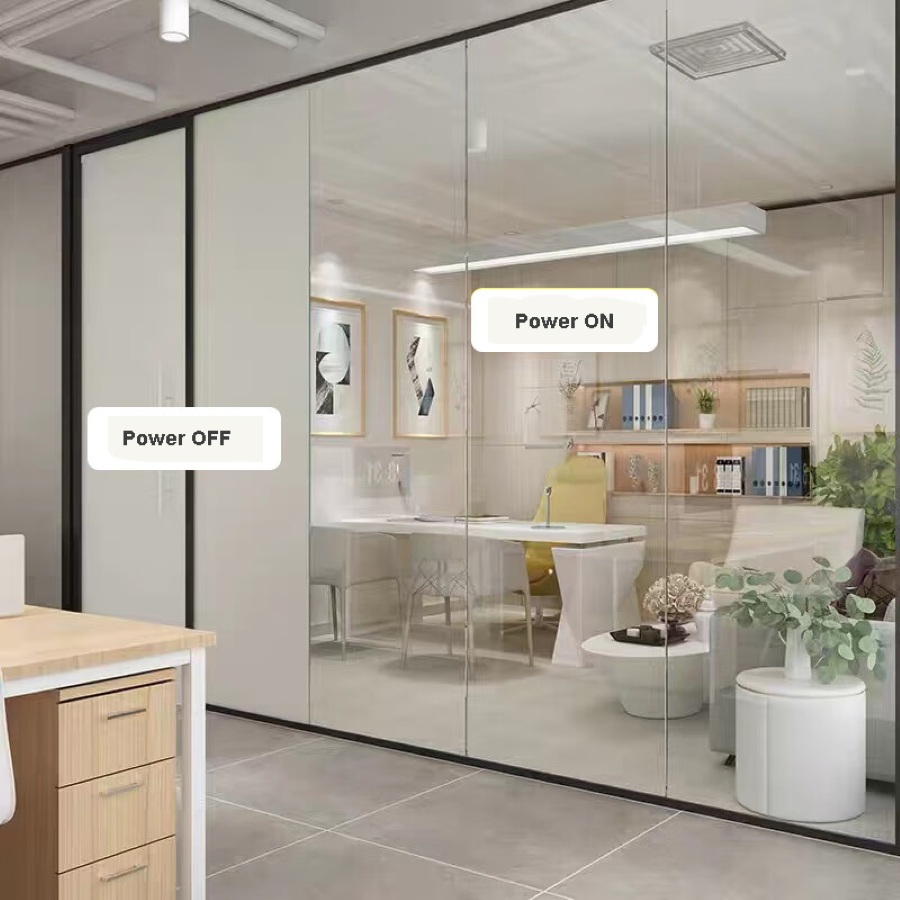
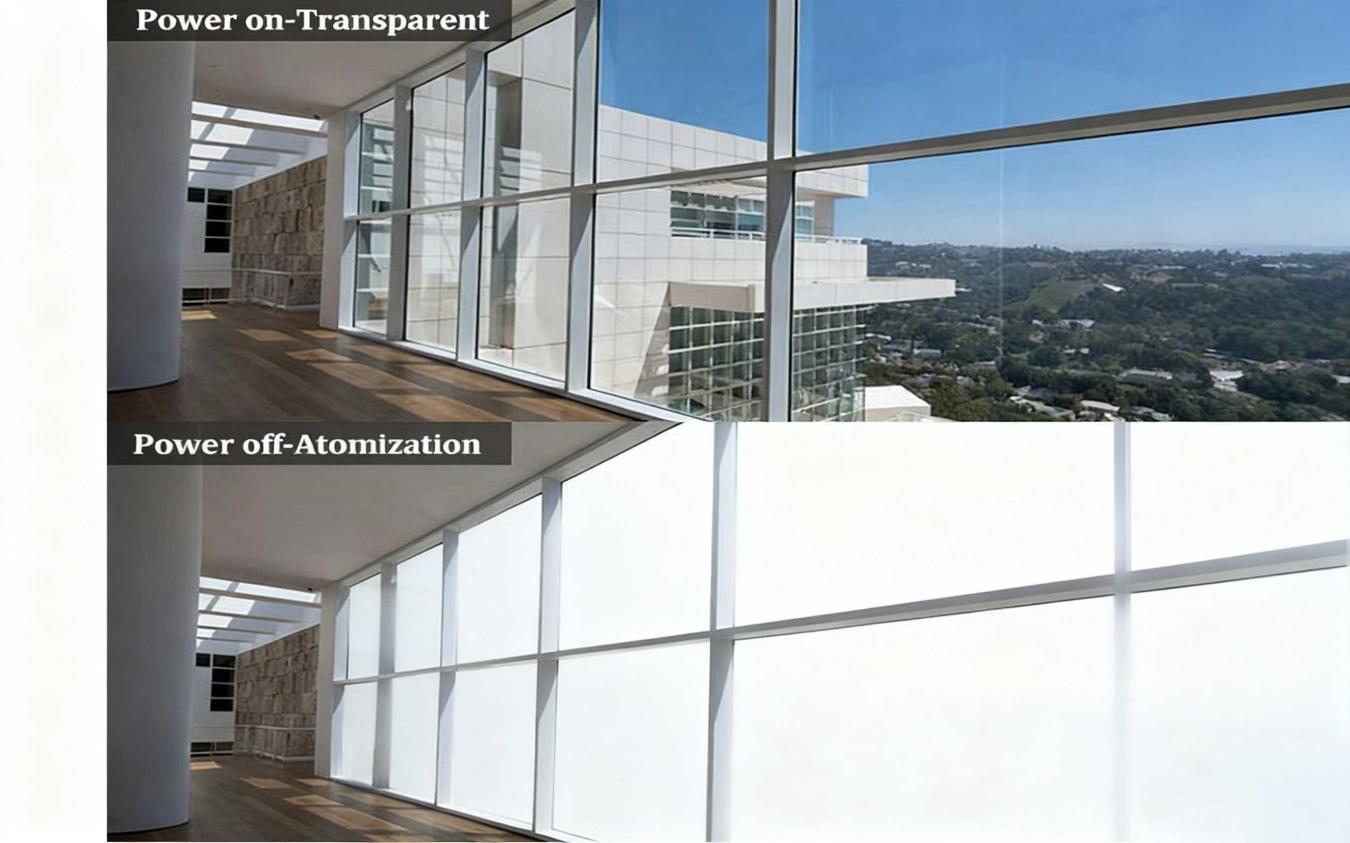
Its working principle is very straightforward: In the power-off state, the liquid crystal molecules are randomly arranged, light is strongly scattered, and the glass appears opaque and fogged, protecting privacy.
In the power-on state, the electric field forces the liquid crystal molecules to align neatly in the same direction, allowing light to pass through smoothly, and the glass instantly becomes transparent.
When this film is sandwiched between two pieces of glass and laminated at high temperature, it becomes a professional PDLC film for laminated glass (laminated dimming film).
Differences from Traditional Privacy Glass Film
Traditional privacy glass films (such as frosted films or one-way vision films) are passive, relying solely on surface texture or coatings. They are easily scratched and peel, and their lifespan is typically only a few years. PDLC, on the other hand, is an active electro-optical material. Especially after professional lamination and encapsulation, its durability, tear resistance, and optical stability have seen a qualitative leap.
What is the average lifespan of high-quality PDLC film in 2026?
It is irresponsible to discuss lifespan without considering the usage environment. Under the industry standards of 2026, different types of dimming films have different expected lifespans. We use the English table below for a direct comparison.
Table 1: Expected Lifespan of PDLC Products in 2026
|
Product Type |
Expected Lifespan |
Typical Application Scenario |
|
Self-adhesive switchable glass film |
5 - 8 Years |
Retrofit projects, temporary office partitions |
|
High-quality PDLC film (Standard) |
8 - 12 Years |
Commercial interiors, hotel bathrooms |
|
Premium PDLC film for laminated glass |
10 - 15+ Years |
High-end residential, architectural facades, medical |
Key Indicators Affecting Lifespan
In laboratory testing, the following four key indicators are mainly considered to determine the longevity of a film:
Switch Cycle Count: High-quality products must be able to withstand more than 1 million consecutive switching cycles without failure.
Optical Attenuation Rate: After five years of use, does the light transmittance decrease by more than 3% under powered conditions, and does the haze remain uniform under powered-off conditions?
UV Weather Resistance: Will it yellow or become brittle after long-term exposure to natural light?
Conductive Layer Stability: Does the resistance of the ITO (Indium Tin Oxide) conductive film drifts over time, leading to localized opacity?
Five Key Factors Affecting PDLC Film Lifespan in 2026
Why do some dimming films remain clear even after ten years, while others develop black spots after only two years? This depends on the following five key factors.
Raw Material Quality (Liquid Crystal Purity & Conductive Film Grade)
This is the fundamental factor determining lifespan. Different PDLC film manufacturers have significant differences in liquid crystal formulations and polymer selection. Low-end products, in order to reduce costs, use liquid crystals with insufficient purity or inferior conductive films, which, over time, are prone to irreversible damage such as edge yellowing and internal leakage (forming permanent transparent spots).
Standardization of Lamination Process
If a semi-finished film is chosen, the subsequent glass processing directly determines its success or failure. using a professional low-temperature vacuum laminator and dedicated EVA film for encapsulation ensures complete air isolation within the film. Using simple lamination or excessively high process temperatures will not only damage the liquid crystal structure but also cause the PDLC film for laminated glass to easily delaminate and bubble later.
Usage Environment
Even the best products are susceptible to damage from extreme environments.
- High Temperature Exposure: Prolonged exposure to direct sunlight above 60°C accelerates the aging of polymer materials.
- High Humidity: If the edge sealing is not done properly, moisture intrusion will quickly damage the conductive layer.
- High Frequency and High Voltage: The extremely frequent switching in commercial spaces poses a significant challenge to the film's fatigue resistance.
Power System Stability
The power supply is like the heart of the dimming film. Unstable voltage fluctuations and inferior transformers will continuously generate abnormal electric field impacts on the liquid crystal molecules, accelerating their electrochemical degradation. A high-quality control system outputs pure sinusoidal AC power, a key guarantee for extended lifespan.
Installation Process and Edge Sealing
Over 40% of after-sales problems stem from improper installation. Failure to use dedicated neutral silicone structural adhesive for edge sealing leads to acid and alkali corrosion; or accidental micro-short circuits during wiring can significantly reduce the film's lifespan. Professional installation and rigorous moisture-proof sealing are indispensable.
Does combining PDLC film with laminated glass extend its lifespan?
The answer is yes.
Why is PDLC film for laminated glass more stable?
When the PDLC film is securely encapsulated between two panes of glass and an EVA interlayer, it wears an "ultimate bulletproof vest."
Double-layer glass protection: Completely isolates it from physical scratches during daily cleaning, acid and alkali detergent corrosion, and accidental impacts.
Enhanced oxidation resistance: In the oxygen-free environment of vacuum lamination, the probability of oxidative degradation of the liquid crystal and conductive layer is minimized.
Superior UV Protection: The glass and specialized EVA film block over 99% of damaging UV rays, significantly slowing down the yellowing and aging process of the material.
Recommended Solutions for Commercial and Architectural laminated Glass Projects
Based on the above advantages, we recommend laminated smart glass as the primary solution for large-scale projects in 2026:
Office Partitions: Ensures long-term stability under high-frequency switching, reducing long-term maintenance and replacement costs for businesses.
Medical Privacy Spaces: Such as ICU wards or infant observation rooms, the pure glass surface structure facilitates deep disinfection and cleaning, and has a long lifespan.
High-End Residences: Bathroom privacy windows, sunroom roofs, capable of withstanding harsh humid and hot environments.
How to Choose High-Lifespan PDLC Film Suppliers in 2026?
High-Lifespan PDLC Film Suppliers
In the complex global market, finding a reliable supplier is the final piece of the puzzle for project success.
Five Criteria for Judging High-Quality PDLC Film Suppliers
We need to look beyond marketing rhetoric to the essence:
- Do they possess a high-level cleanroom production system (dust-free operation is a prerequisite for ensuring no impurities and no short circuits)?
- Can they provide authoritative third-party weathering test reports (such as 85°C/85%RH damp heat test)?
- Do they support comprehensive sample making and preliminary testing?
- Do they possess international export and safety certifications such as CE, RoHS, and SGCC?
- Can they provide real-world large-scale project case studies with over 5 years of operation?
We use the table below to compare the differences between ordinary suppliers and top-tier manufacturers.
Table 2: Evaluating PDLC Film Suppliers
|
Evaluation Criteria |
Standard pdlc film suppliers |
Premium pdlc film manufacturers |
|
Production Environment |
Conventional workshop |
Class 10,000 (or better) Cleanroom |
|
Quality Control Testing |
Basic functional check |
Comprehensive aging, UV, and cycle tests |
|
Technical Support |
Sales guidance only |
Detailed processing & installation protocols |
|
Warranty Provided |
1 - 2 Years |
5+ Years extended warranty |
|
Global Certifications |
Local standards only |
International (CE, SGCC, FCC, RoHS) |
Direct Purchasing vs. Branded PDLC Film Manufacturers
Many buyers choose to purchase from small trading companies to save on initial costs. Although the price is low, the material formulation is extremely unstable, and once a large-scale failure occurs, there is no after-sales service. Choosing a reputable brand manufacturer with strong technological capabilities, while slightly more expensive per unit, ensures stable process support, a lifespan expected to last up to ten years, and comprehensive after-sales service. In construction projects, material stability is always more valuable than price differences.
Future Trends of PDLC Smart Film

Future Trends of PDLC Smart Film
Looking ahead to 2026, the technological iteration of PDLC smart film is accelerating.
Lower Energy Consumption Technology: New liquid crystal formulations reduce operating voltage from the conventional AC 110-240V to DC 24V or even 12V, making it safer and more energy-efficient, making it safer and more energy-efficient.
Higher Transparency: The industry is tackling the "haze" problem; future power-off transparency will be nearly indistinguishable from ordinary high-transparency float glass.
Longer Lifespan: With upgrades in anti-aging materials and encapsulation processes, a lifespan of over 15 years without degradation will become the new industry standard.
Integration with Smart Building Systems: Dimming films will be fully integrated into the building's Internet of Things (IoT) control system, automatically adjusting light transmission based on the angle of solar radiation.
FAQ
Q1: How long does PDLC film typically last?
Brief Answer: Regular self-adhesive film lasts approximately 8–12 years, while high-end laminated smart glass can last 10–15 years or more under normal use and maintenance.
Q2: Is PDLC film for laminated glass more durable?
A: Yes. The lamination structure completely seals the film between two layers of glass, effectively blocking air, moisture, physical scratches, and most ultraviolet rays, significantly improving weather resistance and lifespan.
Q3: Does privacy glass film turn yellow over time?
A: Lower-end films, due to a lack of UV absorbers or the use of inferior polymers, are prone to yellowing under prolonged sunlight exposure. High-quality products use a specialized UV-resistant and stable formula, maintaining pure color for a long time.
Q4: How to choose reliable PDLC film suppliers?
A: Focus on the cleanliness level of their production workshops, request long-term weathering test reports, evaluate the actual operating time of their global engineering projects, and confirm whether they provide comprehensive control system matching and installation guidance.
Conclusion: The Real Lifespan of High-Quality PDLC Film in 2026
Based on the in-depth analysis above, we can draw a clear conclusion. Under the technical standards of 2026, the real lifespan of dimming films exhibits a stepped distribution:
Ordinary laminated products: 5–8 years
High-quality PDLC smart film: 8–12 years
Laminated PDLC film for laminated glass: 10–15 years or even longer
The lifespan of this film is determined not only by the material itself. Choosing a reliable PDLC film manufacturer with strong R&D capabilities and stringent quality control, coupled with professional glass processing and edge sealing technology, and using a stable and clean power control system, are all indispensable.
Smart privacy glass is a future-oriented spatial investment. When you are budgeting for your next building or decorating project, include "long lifespan and low maintenance rate".