How Long Does PDLC Smart Film Last? Lifespan, Haze, Edge Failure and Maintenance
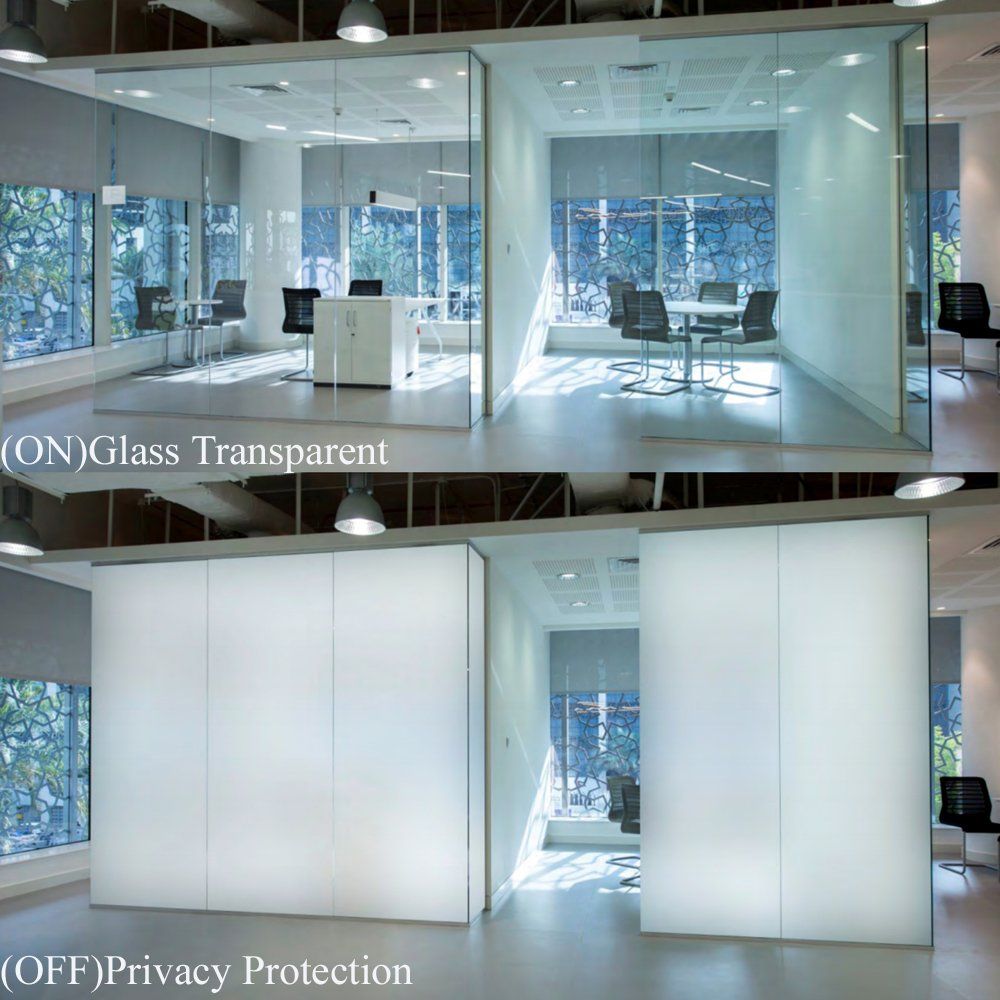
PDLC Smart Film is often selected for projects where privacy, daylight and clean interior design need to work together. It can turn ordinary glass from transparent to frosted, replacing curtains or blinds in offices, hotels, healthcare spaces, retail displays and residential interiors.
Before choosing a product, most buyers want to understand one practical issue: how long does PDLC Smart Film last? The answer depends less on a single number and more on the product structure, installation method, humidity level, power supply and maintenance routine.
In general, high-quality self-adhesive PDLC Smart Film used indoors can provide many years of service when installed and maintained correctly. Laminated switchable glass usually offers a longer and more stable service life because the PDLC layer is sealed inside the glass structure. For procurement teams, architects and glass processors, understanding these differences can help avoid early haze, yellowing, edge failure and replacement costs.
Quick Answer: How Long Does PDLC Smart Film Last?
The lifespan of PDLC Smart Film is usually affected by three things: film quality, installation quality and environment.
| Product Type | Typical Use | Lifespan Expectation | Key Risk |
|---|---|---|---|
| Self-Adhesive PDLC Smart Film | Existing glass, retrofit projects, offices | Long-term indoor use; E&N specification lists >50,000 hours | Edge sealing, surface scratches, humidity |
| PDLC Film for Lamination Glass | Glass processing, smart glass manufacturing | Depends on lamination quality and use environment | Lamination process, interlayer compatibility |
| Laminated Switchable Glass | Hotels, bathrooms, hospitals, premium interiors | Generally more protected and durable | Higher initial cost |
| Low-quality or poorly installed film | Temporary or low-budget projects | Usually shorter and less stable | Yellowing, bubbles, high haze, delamination |
A product's hour rating should not be read in isolation. A film used continuously every day will age differently from one used only during meetings or privacy moments. The installation environment also matters. A dry interior office partition is much easier on smart film than a bathroom panel exposed to steam, cleaning liquid and frequent touch.
What Makes PDLC Smart Film Age Over Time?
PDLC stands for Polymer Dispersed Liquid Crystal. When power is off, the liquid crystal molecules scatter light, creating a frosted privacy effect. When AC power is applied, the molecules align and allow more light to pass through, making the glass appear clear. Because the film uses an electrical and optical material structure, its performance can gradually change under certain conditions. The most common aging factors include:
- UV exposure
- High temperature
- Moisture at the film edge
- Poor edge sealing
- Wrong or unstable voltage
- Harsh cleaning chemicals
- Surface scratches
- Low-quality adhesive or conductive layers
- Poor installation environment
A well-made film can remain visually stable for years, but even a good film may fail early if installed in a humid area without edge protection. For this reason, lifespan should always be considered together with application conditions.
Self-Adhesive Smart Film vs Laminated Switchable Glass
Many users search for both PDLC Smart Film and switchable glass lifespan because they are deciding between two product structures.
Self-Adhesive PDLC Smart Film
Self-adhesive film is applied directly to existing glass. It is suitable for retrofit projects where removing the glass would be expensive or inconvenient. It is commonly used for:
- Office partitions
- Conference rooms
- Residential windows
- Retail display glass
- Advertising projection panels
- Interior privacy screens
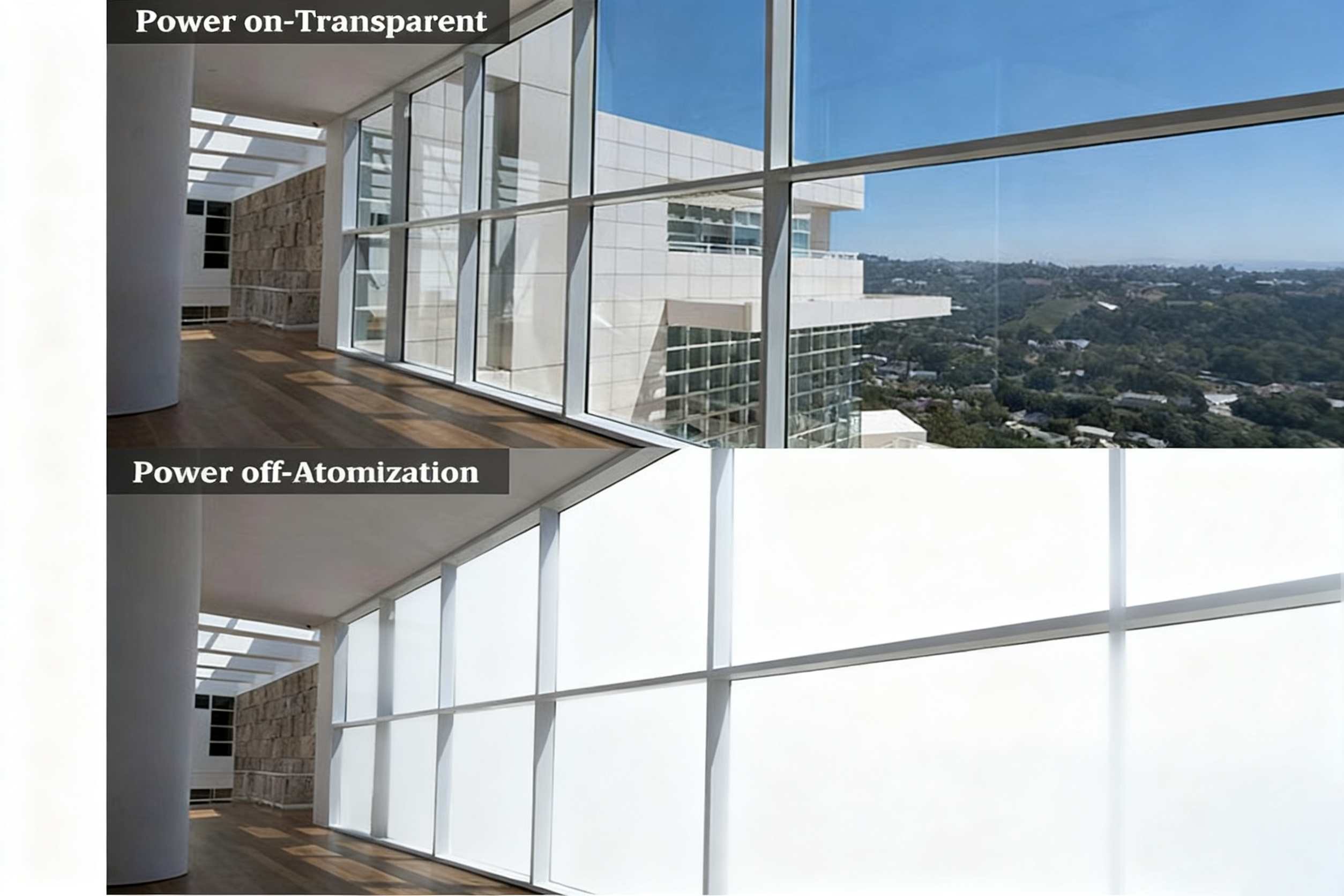
E&N Self-Adhesive PDLC Film offers approximately 80% transparency in the ON state, about 5% transmittance in the OFF state, operates at AC 60V, and consumes around 6W/m². These values make it practical for indoor privacy control where fast installation and cost efficiency are important. The main limitation is that the film surface and edges remain exposed. Good installation and regular smart film maintenance are therefore essential.
Laminated Switchable Glass
Laminated switchable glass places the PDLC layer between glass sheets. This structure protects the functional film from direct contact, cleaning abrasion and moisture exposure. It is often a better choice for:
- Hotel bathrooms
- Healthcare facilities
- Public areas
- Premium residences
- High-traffic commercial interiors
- New construction projects
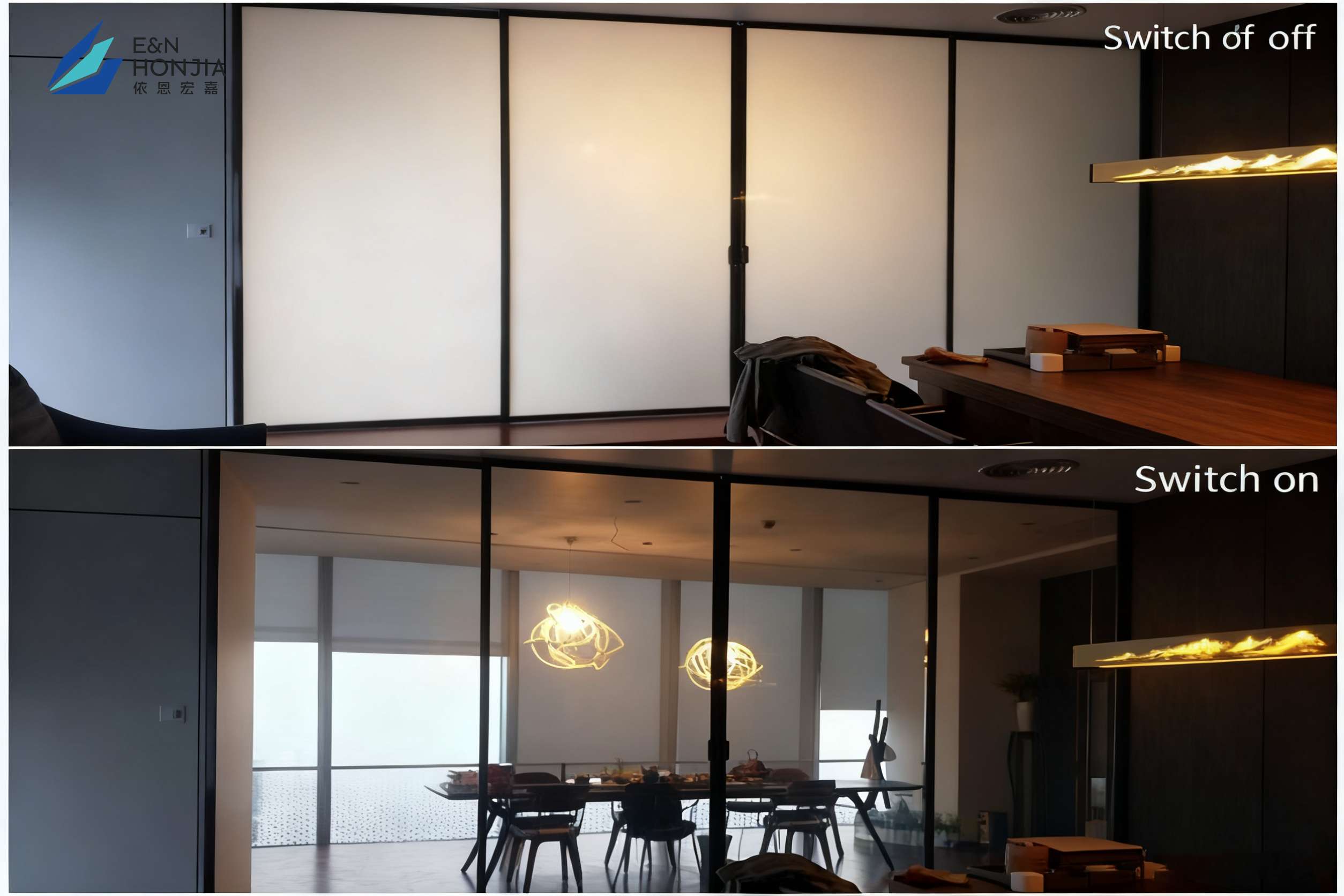
E&N Smart Glass specifications include up to 90% transparency when powered on, OFF-state haze above 95%, AC 48–65V operating voltage, 4–5W/m² power consumption, switching time below 0.2 seconds, and UV blocking above 99%. For projects where long-term stability is more important than retrofit convenience, laminated switchable glass is usually the safer choice.
PDLC Smart Film For Lamination Glass
Is Haze Normal in PDLC Smart Film?
A certain level of haze is normal in PDLC technology. Even in the clear state, PDLC Smart Film may not look exactly like ordinary clear glass. This is because the film controls visibility by managing light scattering.
The important point is to distinguish normal haze from problem haze.
| Visual Condition | Normal or Problem? | Possible Meaning |
|---|---|---|
| Slight milky tone when powered on | Normal | Natural PDLC optical behavior |
| Haze more visible from side angles | Usually normal | Viewing angle effect |
| Uniform frosted look when powered off | Normal | Privacy mode |
| Sudden increase in haze | Problem | Voltage, moisture or material aging |
| White cloudy edges | Problem | Possible edge failure |
| Yellow or brownish tint | Problem | UV aging or material degradation |
| Uneven clear areas | Problem | Electrical or busbar issue |
For users who require very clear viewing, such as retail windows or premium interior glass, sample testing is important. A small powered sample should be checked from different angles and under project lighting conditions. Product photos alone are not enough to judge actual haze performance.
Why Edge Failure Happens
Edge failure is one of the most important issues in PDLC Smart Film lifespan. In many cases, the center of the film remains stable while the edges begin to show problems.
Common signs include:
- Edge whitening
- Bubbles near the border
- Film lifting or peeling
- Cloudy edge lines
- Dead areas near the busbar
- Flickering or unstable switching
- Local delamination
- Corrosion around wiring points
The edge is vulnerable because it is where moisture, cleaning liquid, dust and wiring stress are most likely to enter the system. If water reaches the adhesive layer or conductive busbar area, it may cause visual defects or electrical instability.
This is why edge sealing is not a minor detail. For self-adhesive PDLC Smart Film, proper sealing helps reduce the risk of moisture ingress. For high-humidity environments such as bathrooms, spas and hotel wet areas, laminated switchable glass is generally more suitable because the PDLC layer is enclosed inside the glass.
What Shortens the Lifespan of PDLC Smart Film?
1. Poor Material Quality
Material quality affects optical clarity, yellowing resistance and switching stability. A lower-cost product may perform well at first but develop higher haze, bubbles or edge defects after exposure to heat, UV light or humidity.
When comparing suppliers, buyers should ask for real technical values such as transparency, haze, voltage, power consumption, film thickness and recommended use environment.
2. Incorrect Installation
Self-adhesive smart film requires a clean glass surface and a controlled installation process. Dust, oil, water spots or trapped particles may cause visible defects. Uneven pressure can also increase the chance of bubbles or weak adhesion. Installation should pay special attention to:
- Glass cleaning
- Film alignment
- Dust control
- Wiring position
- Busbar protection
- Edge sealing
- Transformer matching
3. Moisture and Humidity
Moisture is one of the most common causes of early failure. The problem usually begins at the edge rather than the center of the panel.
High-risk areas include:
- Bathrooms
- Shower glass
- Hotel rooms
- Spa areas
- Exterior-facing glass
- Poorly ventilated rooms
- Areas cleaned frequently with liquid sprays
If the project has regular steam or water exposure, laminated smart glass should be considered early in the design stage.
4. Wrong Power Supply
PDLC film requires a suitable AC power supply. A wrong transformer, unstable voltage or poor wiring may cause flickering, uneven switching or long-term performance problems.
For large panels or multi-panel projects, the power load should be calculated before installation. It is also important to avoid exposed wiring in areas where users may touch or clean the glass frequently.
5. Harsh Cleaning Methods
Smart film should not be cleaned like ordinary glass with strong chemicals or sharp tools. Abrasive pads, blades and ammonia-heavy cleaners can damage the surface or edge area.
A simple rule is useful: clean the surface gently and keep liquid away from the edges.
Smart Film Maintenance Guide
Good smart film maintenance is simple, but it should be consistent.
Routine Cleaning
Use the following method for regular cleaning:
1. Turn off the power before cleaning if possible.
2. Use a soft microfiber cloth.
3. Apply mild cleaner to the cloth instead of spraying directly onto the film.
4. Wipe gently without pressing hard.
5. Keep edges and wiring areas dry.
6. Avoid alcohol-heavy, ammonia-heavy or abrasive cleaners.
7. Do not use blades or scrapers.
Monthly Inspection
For commercial projects, a quick monthly check can help detect problems early.
| Area to Check | What to Look For |
|---|---|
| Film edges | Lifting, bubbles, whitening, water marks |
| Film surface | Scratches, permanent marks, cloudy patches |
| Switching effect | Slow response, flickering, uneven transparency |
| Busbar area | Discoloration, loose cover, exposed wiring |
| Power supply | Heat, noise, unstable output |
| Sealant | Cracks, gaps, poor adhesion |
Maintenance for Hotels, Offices and Clinics
In high-use commercial spaces, maintenance should be more structured. Cleaning teams should know that PDLC film is an electrical privacy material, not just a decorative film. They should avoid soaking the edges and should report any whitening, bubbling or switching delay as soon as it appears.
For hotels and clinics, laminated switchable glass can reduce surface damage and simplify cleaning because the PDLC layer is protected inside the glass.
How to Choose the Right PDLC Product
The right PDLC product depends on how the glass will be used. Before ordering, check three things: whether the glass is already installed, whether the space is humid, and how often the surface will be cleaned or touched.
| Project Condition |
|
|
| Existing indoor glass | Self-Adhesive PDLC Smart Film | Fast retrofit without replacing glass |
| Factory glass production | PDLC Film for Lamination Glass | Designed for laminated smart glass processing |
| Bathroom, hotel or public space | Laminated Switchable Glass | Better protection against moisture and surface damage |
| Office partition or meeting room | Self-Adhesive Film or Smart Glass | Depends on whether the glass is existing or new |
| Retail display or projection use | Self-Adhesive PDLC Smart Film | Flexible privacy and display function |
For simple indoor retrofit projects, Self-Adhesive PDLC Smart Film is usually the most practical choice. It can be applied to existing flat glass and is suitable for offices, meeting rooms, residential interiors and retail displays.
For glass processors, PDLC Film for Lamination Glass is the better option. It is used inside laminated glass, so buyers should check lamination compatibility, haze level, operating voltage, power consumption and roll size before production.
For humid, public or high-use areas, Laminated Switchable Glass is usually more stable in the long term. Because the PDLC layer is sealed inside the glass, it is better protected from moisture, cleaning liquid, scratches and edge damage.
Before bulk purchase, compare ON-state transparency, ON-state haze, OFF-state privacy, voltage, power consumption, switching speed and edge sealing requirements. For appearance-sensitive projects, testing a sample under real lighting conditions is still the safest way to judge clarity and haze.
Conclusion
PDLC Smart Film can provide long-term privacy control when the product type matches the environment and the installation is handled correctly. For dry indoor retrofit projects, self-adhesive PDLC film is an efficient solution. For glass processors, PDLC film for lamination offers flexibility in smart glass production. For wet areas, public spaces and high-end interiors, laminated switchable glass usually provides better protection and service stability.
The most important factors are clear: choose reliable material, use the correct voltage, protect the edges, control moisture and clean the film gently. When these details are handled properly, PDLC Smart Film can remain a practical and durable privacy solution for offices, hotels, healthcare spaces, retail environments and residential interiors.