Everything You Want to Know About Smart Glass
Smart glass brings flexibility to architectural glass. It can change from transparent to frosted for privacy, adjust tint for glare control, or support projection and display functions. Instead of treating glass as a fixed surface, designers and building owners can use it to respond to changing needs throughout the day.
For an office meeting room, the priority may be instant privacy. For a hotel bathroom, the focus may be openness without sacrificing comfort. For a façade or skylight, glare and solar heat may be the main concern. Choosing the right smart glass solution starts with understanding the intended use of the space.
At E&N Honjia, we provide PDLC smart film, laminated smart glass, EVA interlayers, SGP interlayers, and glass processing materials for architectural glass projects. The right combination depends on glass structure, installation conditions, safety requirements, and the expected user experience.
What Is Smart Glass?
Smart glass is architectural glazing that changes its transparency, opacity, tint, or light transmission in response to electricity, heat, or sunlight. It is also known as switchable glass, privacy glass, dynamic glass, smart film glass, or electric frosting glass.
Smart glass technologies are commonly divided into two groups.
- Active smart glass uses electricity to change its appearance or light-control behavior.
- Passive smart glass responds to environmental factors such as sunlight or temperature without electrical wiring.
For buildings, the most common active smart glass technologies are PDLC, SPD, and electrochromic glass. Each technology serves a different purpose, so the selection should be based on the project requirement rather than the name alone.
How Does Smart Glass Work?
PDLC Smart Glass
PDLC stands for Polymer Dispersed Liquid Crystal. It is widely used in privacy glass for offices, hotels, hospitals, retail spaces, and residential interiors.
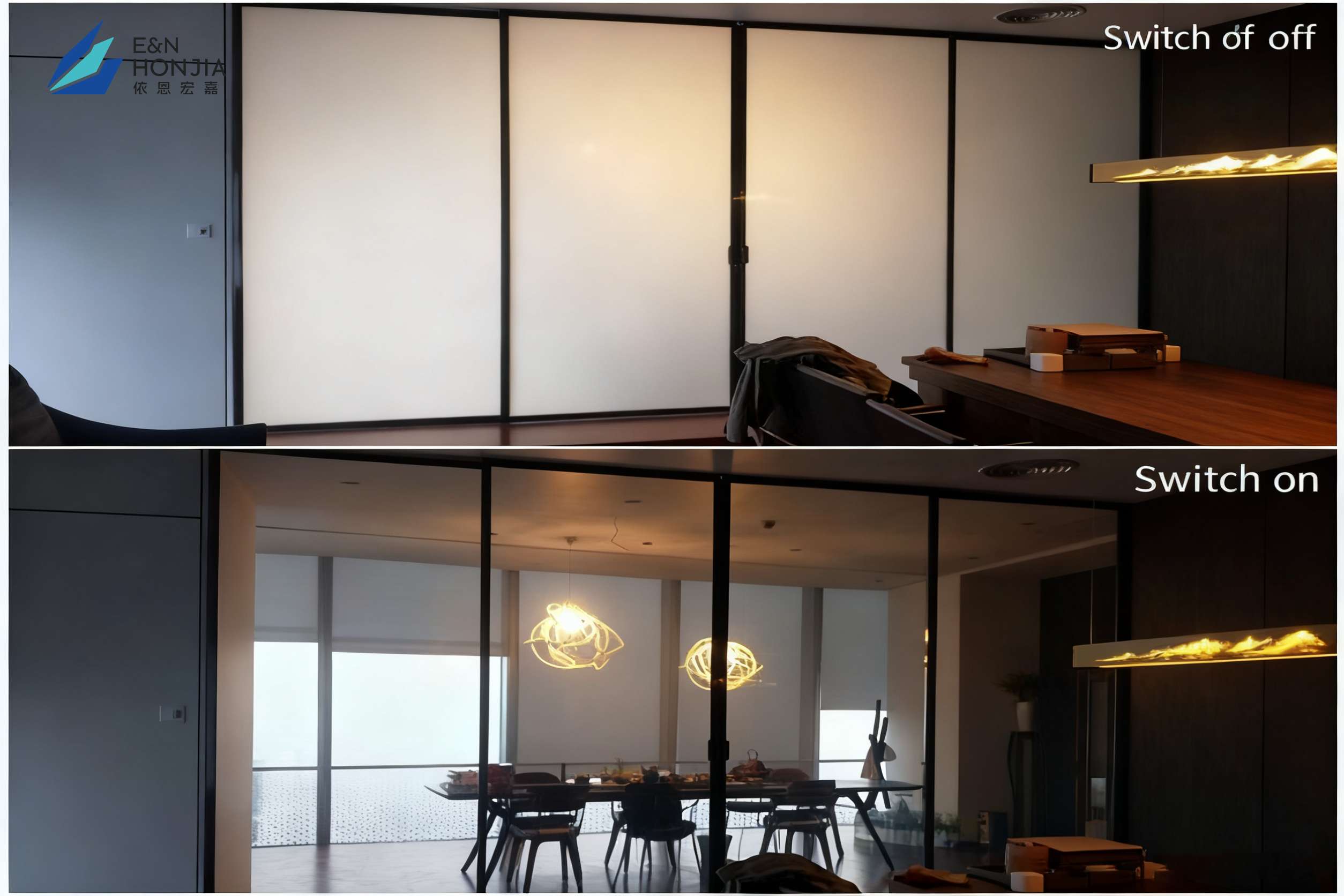
PDLC smart glass contains a liquid crystal film laminated between glass layers. When the power is off, the liquid crystals are randomly arranged and scatter light. The glass becomes frosted or opaque. When power is on, the liquid crystals align and allow light to pass through, making the glass transparent.
A common laminated smart glass structure includes:
Glass + EVA Interlayer + PDLC Smart Film + EVA Interlayer + Glass
This structure protects the smart film inside the laminated glass while supporting safety, durability, and visual consistency. It is suitable for new glass fabrication projects where the complete glass structure can be designed around the intended use.
E&N Honjia's Smart Switchable Glass uses PDLC technology to support instant privacy control in glass partitions, hotel bathrooms, healthcare spaces, retail displays, interior doors, and modern architectural projects.
SPD Smart Glass
SPD stands for Suspended Particle Device. It uses small particles suspended in a film layer to manage the amount of light entering a space. When the particles align, the glass becomes clearer. When they are not aligned, the glass becomes darker.
SPD is often considered for skylights, transportation windows, exterior glazing, and spaces where glare control and shading are more important than complete privacy.
Electrochromic Glass
Electrochromic glass changes tint gradually when a low electrical charge is applied. It is commonly used for exterior windows, façades, and large glazed areas where solar heat gain and daylight management are important.
Unlike PDLC, electrochromic glass usually does not become fully opaque. It is designed to reduce glare and solar exposure while maintaining views through the glass.
PDLC, SPD, and Electrochromic Glass Compared
| Feature | PDLC Smart Glass | SPD Smart Glass | Electrochromic Glass |
|---|---|---|---|
| Main function | Privacy control | Shading and glare control | Gradual tint and solar control |
| Visual change | Clear to frosted | Clear to dark tint | Clear to tinted |
| Suitable for full privacy | Yes | Usually no | Usually no |
| Typical applications | Offices, bathrooms, partitions, healthcare | Skylights, vehicles, view windows | Façades, exterior windows, skylights |
| Switching speed | Fast | Fast | Gradual |
| Retrofit potential | Available for suitable applications | Depends on system design | Usually part of a complete glazing system |
PDLC is often the practical choice when instant privacy is the main goal. SPD and electrochromic glass are more relevant when the project needs a controlled transition between clear and tinted states.
Smart Glass Applications for Modern Spaces
Office Partitions and Meeting Rooms
Open offices benefit from daylight and visual connection, but private meetings still require confidentiality. PDLC smart glass allows glass partitions to remain clear during normal working hours and turn frosted during meetings, interviews, video calls, or presentations.
Before selecting smart glass for an office, consider:
- Whether the glass is new or already installed
- The required level of visual privacy
- Cable routing and power supply location
- Wall switch, remote control, app, or building automation integration
- Glass thickness and partition system compatibility
- Acoustic requirements, which should be evaluated separately from visual privacy
Hotels and Bathroom Privacy Glass
Hotel guest rooms and bathrooms often need privacy without losing the spacious appearance created by glass. Smart glass can switch between transparent and frosted states when guests need privacy, while keeping the room visually open at other times.
For hospitality projects, glass configuration, cleaning conditions, moisture exposure, electrical routing, edge treatment, and frame design should all be confirmed before production.
Healthcare and Clinical Spaces
Hospitals, clinics, laboratories, and treatment rooms may use smart glass partitions where privacy and cleanable surfaces are both important. Glass can be easier to clean than fabric curtains, but the full installation should account for local healthcare requirements, maintenance procedures, and access to electrical components.
Retail Displays and Commercial Interiors
PDLC smart glass can support retail displays, exhibition spaces, product showcases, and presentation rooms. When the glass is transparent, products remain visible. When switched to frosted, the surface can be used for rear projection or privacy.
This makes smart glass useful for commercial spaces that need to change their layout or visual communication without installing permanent signage.
Residential Spaces
In residential projects, smart glass can be used for bathroom doors, interior dividers, balcony enclosures, windows facing neighboring buildings, and home office partitions. It offers privacy without relying on fixed frosted glass, curtains, or blinds.
For exterior residential windows, users should carefully distinguish between privacy needs and solar-control needs. A product that provides privacy may not provide the same thermal performance as a dedicated solar-control glazing system.
Laminated Smart Glass and Self-Adhesive Smart Film
There are two common ways to introduce smart glass technology into a project.
Laminated Smart Glass
Laminated smart glass is produced by placing PDLC film between glass layers with compatible interlayers. It is suitable for new construction, replacement glazing, interior partitions, and projects where the smart film needs to be protected inside the glass.
This approach gives project teams greater control over glass thickness, safety requirements, visual appearance, wire placement, edge treatment, and structural design.
E&N Honjia's PDLC Smart Film for Laminated Glass is designed for lamination with EVA or PVB interlayers. Published typical values include approximately 70% light transmission in the ON state, approximately 4.5% haze in the ON state, AC 36V operating voltage, approximately 3 W/m² power consumption, and switching times of approximately 10 ms from OFF to ON and 100 ms from ON to OFF.
Actual performance should always be confirmed according to the final glass structure, product model, project location, and test conditions.
Self-Adhesive Smart Film
Self-adhesive smart film can be applied to suitable existing glass when replacement is not practical. It may be useful for renovation projects, office upgrades, and interior partitions.
Before choosing retrofit film, confirm the glass condition, visible edge treatment, busbar location, wiring route, cleaning method, power access, and installation environment. Professional installation is important because surface preparation and wire management directly affect the finished appearance.
What Should Be Included in a Smart Glass Inquiry?
A smart glass quotation is more accurate when the project information is complete. Basic dimensions are not enough. The following details help determine a suitable solution:
- Application, such as office partition, hotel bathroom, façade, skylight, glass door, retail display, or residential window.
- Installation location, including indoor or outdoor use, humidity, sunlight exposure, and cleaning conditions.
- Main objective, such as privacy, projection, glare reduction, solar control, or decorative design.
- Required glass structure, including thickness, tempered glass, laminated glass, insulated glass, or safety glass requirements.
- Preferred control method, such as a wall switch, remote control, mobile app, smart home system, or building automation system.
- Panel dimensions, quantity, technical drawings, and required delivery schedule.
- Required tests or samples, including transparency, haze, switching appearance, adhesion, weather resistance, or other project-specific checks.
E&N Honjia can provide samples for quality evaluation and support customized specifications for glass processors and architectural projects.
Smart Glass Quality and Safety Considerations
Smart glass should be evaluated as a complete glazing system. The film, glass, interlayer, electrical components, framing, and installation method all contribute to the final performance.
For laminated architectural flat glass, ASTM C1172 addresses quality requirements for glass made from two or more glass lites bonded with an interlayer. It also recommends mock-ups when optical appearance needs to be evaluated. This is particularly useful for projects involving large panels, interior partitions, decorative glass, or high-visibility applications.
In the United States, certain architectural glazing products may also fall under 16 CFR Part 1201 safety requirements. Local building codes, safety-glazing rules, structural calculations, electrical requirements, and installation responsibilities should be confirmed by qualified local professionals.
For exterior smart glass, performance should be evaluated at the system level. Glass coatings, frame design, cavity construction, orientation, climate, and control strategy all influence energy performance.
The U.S. Department of Energy has reported that dynamic windows can help manage daylight and solar heat gain, which may affect lighting and HVAC demand. These findings are largely related to electrochromic window systems and should not be treated as a general energy-saving claim for every PDLC privacy glass installation.
Common Smart Glass Misunderstandings
Smart Glass Always Controls Heat
Not every smart glass technology provides the same solar-control performance. PDLC is often selected for privacy, while SPD and electrochromic glass are more closely associated with tinting, glare reduction, and solar management.
Smart Glass Replaces Every Blind or Curtain
Smart glass can reduce reliance on blinds in some applications, but it does not automatically replace blackout systems, thermal insulation, acoustic treatments, or decorative window coverings.
Smart Film Is the Complete Solution
Smart film is one part of the finished system. Glass structure, compatible interlayers, edge treatment, control method, wiring, installation quality, and maintenance access all need to be considered.
The Lowest Price Means the Same Performance
A lower quote may use a different glass structure, film specification, control system, panel size, packaging method, quality process, or warranty scope. Compare technical information and samples before making a decision.
Choosing a Smart Glass Manufacturer
A reliable smart glass manufacturer should be able to discuss more than switching effects. The supplier should understand the relationship between PDLC film, laminated glass, interlayers, safety requirements, electrical controls, and project-specific fabrication needs.
Useful questions include:
- Can the supplier provide a sample before volume production?
- Which interlayer is compatible with the selected smart film?
- What glass structures are available?
- What optical and electrical values are provided for the selected model?
- How will wires and busbars be positioned?
- Is the solution suitable for indoor, outdoor, or humid conditions?
- What customization is available for size, glass structure, and control method?
- What testing or quality checks can be provided?
- What lead time applies to the required quantity and configuration?
- Who is responsible for fabrication, installation, wiring, and after-sales support?
E&N Honjia supplies EVA interlayers, SGP interlayers, PDLC smart film, laminated glass, and glass processing accessories for glass processors and architectural projects. Sharing the application, drawings, glass structure, and expected performance requirements at the beginning helps create a more suitable smart glass solution before production starts.